Eli Lilly and Company (NYSE: LLY) has raised its full-year 2026 revenue forecast to between $91 billion and $92 billion after reporting a 39% increase in third-quarter sales to $24.4 billion, driven primarily by continuing global demand for its diabetes and obesity medicines Mounjaro and Zepbound. Announced on October 29, 2026, the results showed that the two tirzepatide brands generated approximately $16.1 billion in combined quarterly revenue, reinforcing the company’s position in the rapidly expanding market for incretin-based metabolic treatments.
The pharmaceutical manufacturer reported third-quarter net income of $6.45 billion, up 16% from the previous year, while reported earnings per share increased to $7.22 from $6.21. Non-GAAP earnings per share reached $7.48, compared with $7.02 a year earlier. However, the results also included approximately $900 million in benefits from sales-based milestones and favourable rebate and discount adjustments, making the distinction between underlying performance and non-recurring contributions important.
Eli Lilly raised the midpoint of its annual revenue forecast by $5.5 billion, reflecting stronger demand and operating performance. At the same time, its full-year non-GAAP earnings guidance moved to $35.00–$36.00 per share from $35.50–$36.50, because substantial acquired research and development charges more than offset improvements in underlying earnings expectations. The results therefore combine strong commercial momentum with significant investment expenditure and increasingly visible pressure on realised drug prices.
Why did Eli Lilly report 39% revenue growth despite a 15% decline in realised prices?
Eli Lilly’s third-quarter revenue increased to $24.397 billion from $17.601 billion a year earlier, reflecting substantial expansion in prescription volumes. The company reported a 53% positive contribution from volume growth, partly offset by a 15% decline in realised prices. This pattern indicates that the business is selling significantly more product while receiving less revenue per comparable unit after accounting for pricing and commercial adjustments.
The United States remained the company’s largest market, contributing $15.1 billion in quarterly revenue, an increase of 34%. Domestic volume grew 41%, while realised prices declined 7%, with Zepbound accounting for an important part of the pricing movement. Higher demand for both Zepbound and Mounjaro was sufficient to outweigh that pressure.
Outside the United States, revenue increased 47% to $9.3 billion as volume expanded 76%. International realised prices declined 29%, partly reflecting Mounjaro’s inclusion on China’s National Reimbursement Drug List. Expanded reimbursement can improve access and utilisation while reducing the revenue received for individual prescriptions.
For investors, the key issue is whether the company can maintain sufficiently strong volume growth as competition, insurance negotiations and government reimbursement arrangements place pressure on prices. Lower realised prices are not automatically negative if improved access creates enough additional demand, but sustainable growth ultimately depends on the relationship between volume, production costs and revenue per treatment.
How did Mounjaro and Zepbound become the dominant drivers of Eli Lilly’s quarterly sales?
Mounjaro generated $10.723 billion in worldwide third-quarter revenue, an increase of 65% from $6.515 billion a year earlier. The United States contributed approximately $5 billion, while international markets generated approximately $5.7 billion. The faster international expansion reflects increasing treatment uptake, although lower realised prices partly offset the benefits of additional prescriptions.
Zepbound generated $5.352 billion in quarterly revenue, up 49% from $3.588 billion. Its United States business accounted for approximately $5.3 billion, making domestic demand central to its current performance. The company attributed growth primarily to increasing utilisation, partly offset by lower realised prices.
Together, Mounjaro and Zepbound accounted for approximately 66% of total third-quarter revenue. Both brands contain tirzepatide, but their approved indications and commercial positioning differ by market. This distinction matters because Eli Lilly is benefiting from one molecular platform across multiple treatment needs, while also concentrating a substantial proportion of revenue in the same underlying medicine.
The combined performance strengthens the company’s financial capacity to support additional manufacturing and pipeline development. However, reliance on the tirzepatide franchise introduces exposure to changes in clinical competition, pricing, reimbursement and patient access. Diversification across newer medicines will become increasingly important if market growth eventually moderates.
Why is the raised $91bn–$92bn revenue forecast not the same as higher earnings guidance?
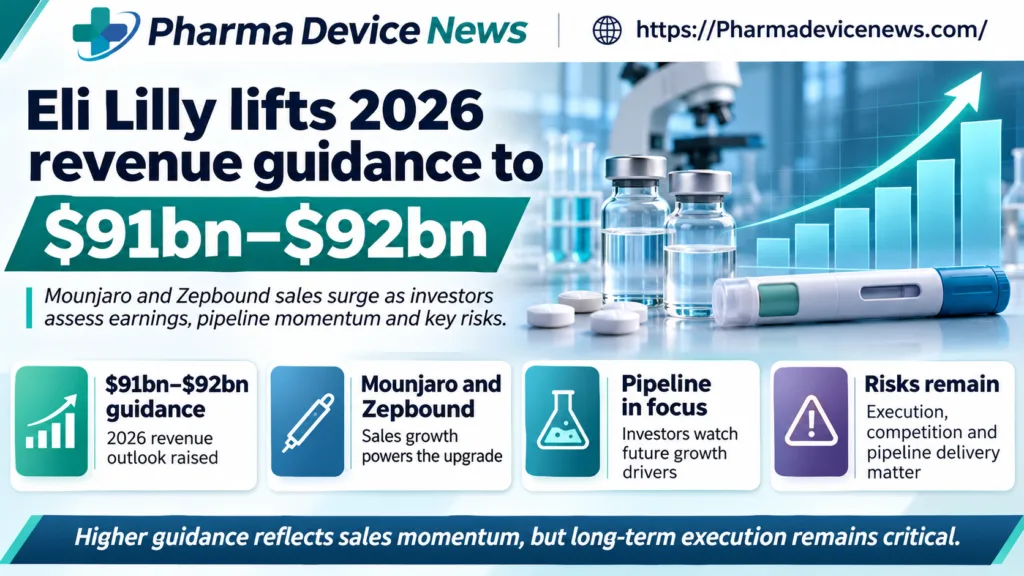
Eli Lilly previously expected full-year revenue between $85 billion and $87 billion. Its updated range of $91 billion to $92 billion represents a $5.5 billion increase at the midpoint and signals substantially stronger expectations for the business. Management also raised its projected non-GAAP performance margin to between 52.0% and 52.5%, compared with its earlier range of 49.0% to 50.5%.
However, full-year non-GAAP earnings per share guidance declined by $0.50 at the midpoint, moving from $36.00 to $35.50. This apparently contradictory change reflects the accounting treatment of acquired in-process research and development expenditure rather than a deterioration of the company’s underlying commercial outlook.
Management said underlying earnings expectations improved by $4.07 per share at the midpoint. That increase was more than offset by $4.57 per share in acquired research and development charges associated with third-quarter business development. The updated guidance therefore incorporates the financial consequences of acquisitions made to strengthen the company’s future pipeline.
This distinction matters when assessing earnings quality. Investors evaluating the operating business may focus on sales, gross margin and underlying performance, while still recognising that acquisitions consume capital and affect reported profitability. Treating the guidance change solely as an earnings downgrade would overlook the improved commercial forecast, while ignoring the acquisition charges would understate the cost of portfolio expansion.
What do third-quarter research spending and acquisition charges reveal about Eli Lilly’s strategy?
Eli Lilly increased third-quarter research and development expenditure by 23% to approximately $4.2 billion, equivalent to 17% of revenue. Marketing, selling and administrative expenses increased 14% to $3.1 billion, reflecting investments associated with existing and planned product launches. These figures demonstrate that rapid sales growth is accompanied by substantial spending across development and commercial operations.
The company also recognised approximately $4.2 billion in acquired in-process research and development charges, compared with $656 million a year earlier. The charges were principally associated with the acquisitions of AtaiBeckley and Curevo. These transactions broaden the company’s research exposure beyond its established metabolic and immunology businesses.
Eli Lilly completed its acquisition of AtaiBeckley during the quarter, adding development programmes focused on treatment-resistant depression and other mental health conditions. Following the quarter’s close, it also completed the acquisition of Merida Biosciences, expanding research into serious autoimmune and allergic diseases. The timing of these transactions matters because not all subsequent acquisition expenditure is reflected in the third-quarter financial results.
The strategic objective is to build a pipeline capable of supporting growth beyond currently successful medicines. However, acquired development assets remain subject to clinical, regulatory and commercial uncertainty. Substantial acquisition spending does not guarantee that the resulting programmes will produce approved treatments or future revenue.
How important are Foundayo and new regulatory approvals to Eli Lilly’s growth beyond injectable GLP-1 medicines?
Eli Lilly’s oral GLP-1 medicine Foundayo, containing orforglipron, generated $184 million in third-quarter revenue following its launch. The figure remains relatively small compared with the tirzepatide franchise, but it establishes an additional commercial product within the company’s metabolic portfolio. The company’s year-to-date Foundayo revenue reached $281 million.
An oral treatment could broaden patient choice and potentially reach individuals who prefer tablets to injections. However, commercial adoption will depend on comparative effectiveness, tolerability, prescribing requirements and payer access. The initial revenue contribution does not establish that Foundayo will reproduce the scale of Mounjaro or Zepbound.
The company also highlighted several recent regulatory approvals. The United States Food and Drug Administration approved Onswik, a once-weekly basal insulin for adults with type 2 diabetes, and expanded Mounjaro’s label to include cardiovascular risk reduction in adults with type 2 diabetes. These developments create additional treatment opportunities, although their financial contributions will depend on actual prescribing and reimbursement.
In oncology, the FDA approved Inluriyo in combination with Verzenio for adults with certain ESR1-mutated, oestrogen receptor-positive, HER2-negative advanced or metastatic breast cancers. Jaypirca also received an expanded indication covering certain previously untreated patients with chronic lymphocytic leukaemia or small lymphocytic lymphoma. These developments reinforce the company’s effort to build revenue streams beyond metabolic disease.
What do retatrutide and the next generation of metabolic medicines mean for future competition?
Eli Lilly reported positive topline results from a Phase 3 head-to-head study evaluating investigational retatrutide against Ozempic 2 mg in adults with type 2 diabetes. According to the company, retatrutide demonstrated greater HbA1c reduction and more than twice the weight loss observed with the comparator under the trial’s conditions. The findings support further regulatory development, but the precise results must be evaluated within the trial’s population and design.
Retatrutide is an investigational triple receptor agonist targeting GIP, GLP-1 and glucagon pathways. Its development reflects the industry’s effort to improve metabolic outcomes beyond those achievable with current treatments. However, a favourable trial against one dose of semaglutide does not establish superiority over every approved obesity or diabetes medicine.
The company also highlighted Phase 2 findings for EloraTZP, a combination involving eloralintide and tirzepatide, in adults with obesity and type 2 diabetes. Phase 3 development was planned to begin during the fourth quarter of 2026. The strategy demonstrates continuing investment in combination therapies that may offer additional metabolic benefits.
These programmes provide potential future growth opportunities but also create development risk. Stronger efficacy may introduce different tolerability considerations, and regulatory approval requires a complete benefit-risk assessment. Eli Lilly’s leadership in existing treatments provides commercial advantages, but future competition will depend on the quality of new clinical evidence.
Why do improving margins and manufacturing investment matter for Eli Lilly’s long-term profitability?
Eli Lilly reported a third-quarter gross margin of approximately $20.5 billion, equivalent to 83.9% of revenue. The percentage increased by one percentage point from the previous year, reflecting favourable product mix and improved production costs. Lower realised prices partly offset these improvements.
The company has been investing heavily in manufacturing capacity to support growth across injectable, oral and other pharmaceutical products. Recent projects include manufacturing expansions in Texas and Virginia. These investments are intended to improve supply capacity and support future product launches, although the timing of full production contributions may vary.
Manufacturing scale is especially important when demand grows faster than the existing supply network can accommodate. Additional production capacity can support improved access, but building and qualifying pharmaceutical manufacturing facilities involves substantial expenditure and regulatory requirements. The benefits therefore emerge over time rather than immediately after an investment announcement.
For investors, the central question is whether production efficiency and higher sales volumes can continue offsetting pricing pressure. The third-quarter gross margin suggests the company is currently achieving favourable operating economics. Maintaining those economics will depend on product mix, manufacturing utilisation and commercial negotiations across different markets.
What does Eli Lilly’s latest stock performance reveal about investor sentiment after the earnings release?
Eli Lilly shares closed at $1,417.54 on October 30, 2026, gaining 3.19% during the session after rising 6.63% on October 29. The two-session advance followed the release of stronger-than-expected third-quarter results and the upward revision to the annual sales forecast. The stock also reached an intraday high of $1,449.68 on October 30.
The positive market reaction reflects investor confidence in the company’s ability to expand prescription volumes and sustain high-margin pharmaceutical sales. Nevertheless, share-price gains cannot be attributed to a single element of the earnings report. Broader expectations concerning new product launches, manufacturing capacity and the metabolic medicine market also influence sentiment.
The company’s valuation incorporates expectations for continued growth, creating a risk that operational performance must remain strong to support investor assumptions. A slower launch, regulatory setback or sharper decline in realised prices could affect future projections. Conversely, additional regulatory approvals and successful late-stage trials could strengthen confidence in the pipeline.
The most important financial indicators will be the company’s ability to meet its updated revenue forecast and maintain margins while funding substantial research and acquisition expenditure. Mounjaro and Zepbound currently provide exceptional commercial momentum, but future performance will depend on how effectively Eli Lilly diversifies beyond these products.
Eli Lilly’s third-quarter results demonstrate a business expanding rapidly despite significant price pressure. The raised revenue forecast, strong gross margin and broadening pipeline support a positive operating outlook, while acquisition charges and product concentration remain important considerations. The next test is whether the company can sustain its commercial growth while converting its extensive pipeline and manufacturing investments into durable financial returns.