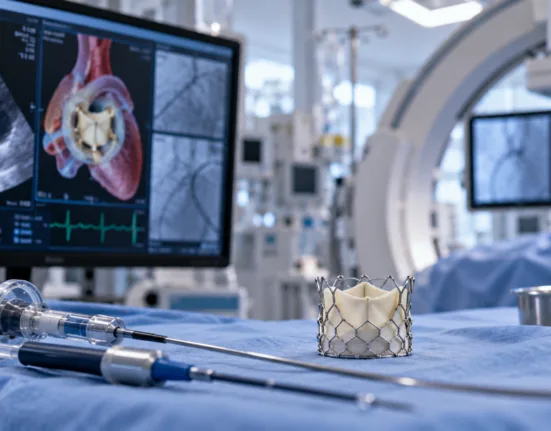
Laplace Interventional, Inc. has treated the first three patients in the randomised cohort of TRIUMPH, its pivotal clinical trial evaluating an investigational transcatheter tricuspid valve replacement system for patients with severe tricuspid regurgitation. Announced on October 29, 2026, the procedures were performed at Ballad Health in Kingsport, Tennessee, and Oklahoma Heart Institute in Tulsa, Oklahoma, marking the transition from early feasibility research into a larger clinical programme intended to support potential regulatory approval.
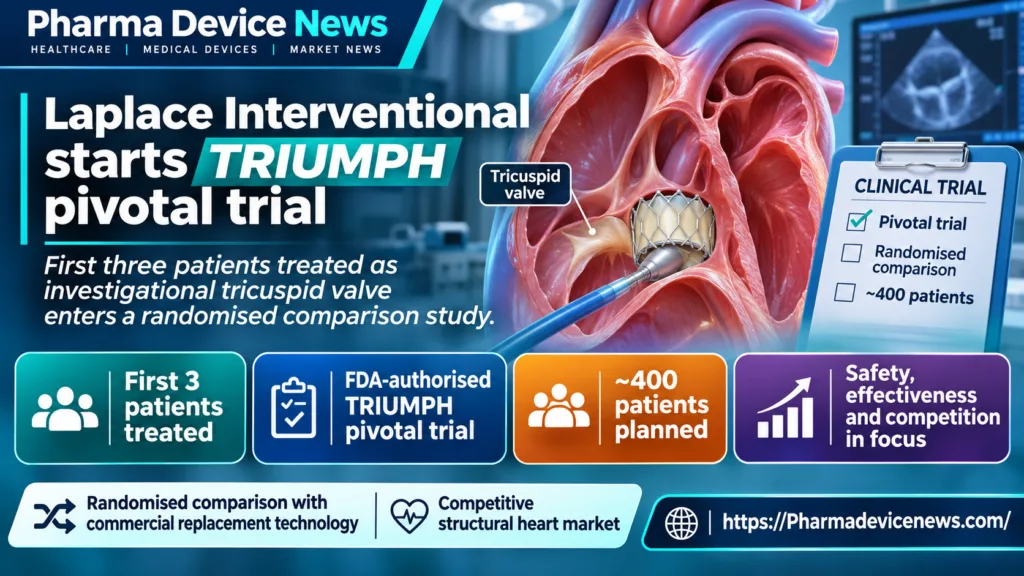
The prospective, multicentre investigation received Investigational Device Exemption approval from the United States Food and Drug Administration in June 2026. TRIUMPH is designed to enrol approximately 400 patients in its randomised cohort across up to 75 centres, comparing Laplace’s investigational valve with commercially available transcatheter tricuspid valve replacement technology using a two-to-one allocation. A separate registry is planned for up to 150 patients who are unsuitable for commercial replacement technology and suboptimal candidates for transcatheter edge-to-edge repair.
The study’s design is commercially significant because Laplace is entering a market where an FDA-approved replacement device already exists. However, the first three procedures establish only that randomised treatment has begun. Laplace has not disclosed clinical outcomes from these patients, and its valve remains investigational and unavailable for commercial use.
Why does the first patient milestone matter for Laplace Interventional’s TRIUMPH pivotal trial?
The initiation of patient treatment represents an important step for a medical device developer moving beyond initial technical feasibility. Early studies can demonstrate that a device can be implanted and may provide an acceptable preliminary safety profile, but they generally involve relatively few patients. Pivotal studies must generate a larger and more persuasive evidence package suitable for regulatory assessment.
Laplace’s first three randomised patients were treated by structural heart teams led by Gaurav Rana at Ballad Health and Kamran Muhammad at Oklahoma Heart Institute. The participation of these centres demonstrates that the company has begun implementing the study protocol across independent clinical institutions. However, the announcement does not identify which treatment each patient received or provide information about procedural success, complications or follow-up.
Ramji Iyer, founder and chief executive officer of Laplace Interventional, has described the milestone as an important source of early clinical momentum. Management is seeking to establish recruitment and treatment activity across the planned multicentre network. The ability to enrol patients consistently will be necessary for generating the evidence required by the pivotal programme.
The distinction between operational progress and clinical success is important. Treating the first patients demonstrates that the study is active, but it does not establish that the investigational valve is safer or more effective than its comparator. Those questions require appropriate analysis after sufficient participants have completed the relevant assessments.
How will the 400-patient TRIUMPH study compare Laplace with commercial tricuspid valve replacement?
TRIUMPH is designed as a prospective, multicentre pivotal investigation under an FDA Investigational Device Exemption. Its principal randomised cohort will allocate patients in a two-to-one ratio between the Laplace system and commercial transcatheter tricuspid valve replacement. This means approximately twice as many patients are expected to receive the investigational treatment as the commercial comparator, assuming the planned allocation is maintained.
The use of an active device comparator distinguishes TRIUMPH from studies that compare a new intervention only with medical therapy. An established replacement treatment can provide a more demanding clinical benchmark because investigators must evaluate outcomes against technology already available for appropriate patients. The study therefore has potential implications for competitive positioning as well as regulatory development.
The planned enrolment of approximately 400 patients across up to 75 centres should allow experience to accumulate across different operators and clinical settings. However, the number of participating institutions does not guarantee that outcomes will be consistent. Differences in patient anatomy, procedural experience and clinical management may influence both safety and effectiveness.
The company has not disclosed a complete primary endpoint framework in its October announcement. It would therefore be premature to describe TRIUMPH as a trial specifically designed to demonstrate superiority, non-inferiority or an advantage on a particular clinical outcome without reference to the final protocol. Its stated purpose is to evaluate the safety and effectiveness of the Laplace system.
The study is registered as NCT07687485. Its longer-term follow-up framework reflects the need to examine durability and complications beyond the immediate procedure. However, the anticipated timing of regulatory submission and potential approval will depend on recruitment, data collection and the resulting clinical findings.
Why is severe tricuspid regurgitation a difficult condition to treat?
The tricuspid valve sits between the right atrium and right ventricle of the heart. Its function is to allow blood to move forward while preventing substantial backward flow during ventricular contraction. Tricuspid regurgitation develops when the valve fails to close properly, allowing blood to leak into the right atrium.
Severe regurgitation can contribute to right-sided heart failure, fluid retention, abdominal swelling, fatigue and reduced exercise tolerance. Some patients develop significant enlargement or dysfunction of the right-sided heart chambers. Treatment decisions can be complicated by advanced age, other cardiac diseases and the patient’s overall suitability for surgery.
Conventional management may include diuretic treatment and interventions addressing related cardiovascular conditions. However, medicines generally do not directly correct the structural failure of a severely leaking valve. Surgical repair or replacement can provide a more definitive mechanical intervention, but some patients face substantial operative risk.
Transcatheter approaches seek to treat the valve through a catheter rather than conventional open-heart surgery. Repair technologies aim to improve the function of the existing valve, while replacement devices implant a new prosthetic valve. These approaches address related problems but are not interchangeable for every patient.
Laplace Interventional has identified a US population of more than 1.6 million people affected by tricuspid regurgitation as part of its commercial rationale. However, this figure should not be treated as the number of patients currently eligible for the investigational valve. Clinical suitability depends on disease severity, symptoms, anatomy and established treatment criteria.
How does the Laplace valve’s design address complex tricuspid anatomy?
The Laplace system uses a self-expanding prosthetic valve designed for catheter-based implantation. Published descriptions of the device identify a nitinol frame carrying a valve made from porcine pericardial tissue. Its anchoring architecture incorporates features intended to secure the replacement valve within the native tricuspid anatomy.
The system has been developed around the challenge of accommodating variation in annular size and leaflet condition. Tricuspid anatomy can be difficult because the annulus may become substantially enlarged, while native leaflets can be displaced, tethered or otherwise unsuitable for certain repair techniques. These characteristics may influence which treatment approach a structural heart team considers appropriate.
Published descriptions indicate that the Laplace device can be repositioned and recaptured until final deployment. This capability could provide operators with flexibility during implantation, particularly when precise positioning is difficult. However, the ability to reposition a valve does not eliminate risks involving anchoring, surrounding structures or conduction tissue.
The system has also been designed for large tricuspid annuli, with published technical descriptions referring to anatomical perimeters of up to approximately 177 millimetres. This could potentially expand the range of anatomies considered for replacement. Nevertheless, the appropriate anatomical limits must be established through device-specific assessment and clinical evidence.
The commercial question is whether these design characteristics translate into easier implantation, fewer complications or better outcomes. Engineering differences can support a rationale for development, but they do not establish superiority over an approved device without comparative testing.
Why are transjugular and transfemoral delivery options important for transcatheter tricuspid replacement?
Laplace has developed approaches allowing its valve to be delivered through venous access in the neck or groin. The transjugular route uses access through the jugular venous system, while transfemoral delivery uses the femoral vein. Both approaches aim to avoid the need for conventional open-heart surgery, although they involve different procedural considerations.
The preferred access route can depend on patient anatomy, delivery-system characteristics and operator experience. A catheter must be advanced and positioned so that the prosthetic valve can be deployed accurately. Differences in the angle of approach may influence how easily the system aligns with the native tricuspid valve.
The company’s earlier feasibility programme has included transjugular implantation, providing experience with that approach before the pivotal programme. Laplace’s broader development strategy now includes alternative access options intended to support flexibility across patients and treatment centres. However, the October announcement does not disclose the access route used in each of the first three randomised cases.
Access-site complications remain an important safety consideration. Bleeding, vascular injury and other procedural events can occur even when open surgery is avoided. Device delivery must therefore be evaluated as part of the complete treatment strategy rather than separately from valve performance.
The availability of two potential routes may ultimately be useful if clinical teams can select the approach best suited to individual anatomy. However, TRIUMPH must establish the safety and effectiveness of the relevant procedure configurations. The existence of multiple delivery options does not independently demonstrate lower procedural risk.
What have earlier Laplace feasibility studies established about procedural performance?
Before TRIUMPH, Laplace evaluated its device through an early feasibility study involving patients with severe symptomatic tricuspid regurgitation. The investigation was designed to assess technical performance and initial safety rather than provide definitive comparative efficacy evidence. The study has been registered as NCT06183684.
Published reviews of the developing transcatheter tricuspid valve field have summarised experience involving the first 35 treated patients. These reports described a median device time of approximately 44 minutes and reduction of tricuspid regurgitation to none or mild in approximately 87% of patients. Such findings provide preliminary evidence of technical effectiveness.
However, the early feasibility experience also involved important complications. Published summaries described major access-site complications in two patients, unplanned valve reintervention in two patients and pacemaker implantation associated with conduction disturbances in three patients. These observations underscore the need for larger studies and continued refinement of the device and procedure.
The uncontrolled nature of early feasibility research limits comparisons with established treatments. Patients may differ in anatomy, disease severity and other characteristics that influence outcomes. Furthermore, a successful immediate reduction in valve leakage does not necessarily establish durable improvement in survival, heart failure symptoms or quality of life.
Laplace has announced that one-year results from its transjugular early feasibility study will be presented at Transcatheter Cardiovascular Therapeutics on November 2, 2026. Kashish Goel is scheduled to deliver the presentation. Those one-year findings were not included in the October 29 announcement and should not be represented as already disclosed results.
How does TRIUMPH position Laplace against Edwards Lifesciences’ approved EVOQUE system?
Edwards Lifesciences Corporation received FDA approval for its EVOQUE transcatheter tricuspid valve replacement system on February 1, 2024. The device is authorised for selected patients with symptomatic severe tricuspid regurgitation despite optimal medical therapy when the heart team considers replacement appropriate. Its commercial availability provides an established benchmark for emerging replacement technologies.
EVOQUE uses a self-expanding prosthetic valve delivered through a catheter-based approach. Its pivotal clinical programme demonstrated substantial reduction of tricuspid regurgitation and improvements in patient-reported health status compared with medical therapy alone. However, the treatment also carries procedural risks that must be considered when selecting patients.
Laplace’s decision to compare its investigational technology with commercial transcatheter replacement creates a potentially important competitive study. If TRIUMPH demonstrates acceptable outcomes, the results could help clinicians evaluate whether another replacement system offers useful alternatives for particular anatomical or procedural circumstances. However, the trial has not yet established any comparative advantage.
It is also important not to equate all transcatheter tricuspid interventions. Edge-to-edge repair and valve replacement differ in how they address the underlying valve problem. Some patients may be suitable for one intervention but not another, and comparative conclusions require attention to the intended treatment population.
The evolving market may ultimately support several devices with different anatomical strengths. For Laplace, the critical requirement is demonstrating that its design delivers clinically relevant performance rather than relying solely on engineering differentiation.
Why does TRIUMPH include a separate registry for patients unsuitable for commercial replacement?
The pivotal programme includes an additional planned registry of up to 150 patients who are unsuitable for commercial transcatheter tricuspid valve replacement and suboptimal candidates for transcatheter edge-to-edge repair. This group is distinct from the randomised cohort and addresses patients whose anatomy or clinical circumstances may limit existing treatment options.
A separate registry can provide information about the feasibility of treating patients who might not qualify for the main comparative study. Such evidence may be relevant when considering whether a device can address difficult anatomical configurations. However, registry findings have different interpretive limitations from randomised comparisons.
Patients entering the registry may have more complex anatomy or different clinical risk characteristics. Their outcomes therefore cannot automatically be compared with those of randomised patients without considering these differences. The registry should not be described as proving broader eligibility or superiority over existing devices.
Its commercial significance lies in the possibility of identifying an additional treatment population. However, any eventual regulatory claim would require appropriate evidence supporting the device’s safety and effectiveness in that population. Registry enrolment alone does not establish a future authorised indication.
The combination of a randomised cohort and a separate registry gives Laplace an opportunity to investigate both competitive performance and challenging clinical needs. The value of that structure will depend on successful recruitment and the quality of the resulting data.
What safety and effectiveness outcomes will determine whether the Laplace valve can secure FDA approval?
Regulatory assessment of a transcatheter heart valve requires evidence addressing both procedural safety and the durability of treatment. Potential safety events include bleeding, vascular complications, valve dysfunction, conduction abnormalities, pacemaker implantation and other cardiovascular complications. The frequency and clinical consequences of these events must be evaluated in the context of the intended population.
Effectiveness involves more than immediate implantation success. The valve must reduce regurgitation and continue functioning appropriately over time. Patient symptoms, exercise capacity, quality of life and the occurrence of heart failure-related events may also be clinically relevant.
The active-comparator design makes careful endpoint interpretation especially important. An investigational device might demonstrate comparable reduction in valve leakage while differing in procedural risks or subsequent clinical outcomes. The overall benefit-risk assessment must consider these dimensions together.
Follow-up durability will also influence commercial confidence. A replacement valve intended to remain implanted for years must provide evidence concerning structural integrity, haemodynamic performance and longer-term complications. Initial procedural results cannot answer all these questions.
FDA IDE approval permits the investigational study to proceed but does not authorise commercial marketing. A subsequent approval application would require the relevant clinical and technical evidence. Laplace has not announced that its valve is commercially available in any country.
What does the pivotal trial mean for Laplace Interventional’s financing and commercial prospects?
Laplace Interventional is a privately held clinical-stage medical device company based in Minnesota. Its development strategy focuses on creating a transcatheter replacement option for patients with tricuspid regurgitation. The company has not disclosed current revenue, profitability or a valuation associated with the October clinical milestone.
A multicentre pivotal study involving approximately 400 randomised patients represents a substantial operational commitment. Costs may include clinical site support, device manufacturing, procedure coordination, imaging assessment and long-term follow-up. Recruiting the separate registry population could introduce additional expenditure.
The existence of an FDA-approved competitor creates both an opportunity and a commercial challenge. It demonstrates that a US market pathway exists for transcatheter tricuspid replacement, but Laplace must show that its technology can compete within the established treatment landscape. Differentiation may involve anatomy, procedural performance or other clinically relevant characteristics.
The company has not announced a new financing transaction, commercial partnership or acquisition agreement associated with the first three procedures. Consequently, the clinical milestone should not be interpreted as confirmation of additional funding or a future sale. Commercial opportunities remain conditional on trial outcomes and regulatory authorisation.
The next indicators of progress will include the scheduled November 2 early feasibility presentation, recruitment across TRIUMPH sites and subsequent clinical updates. Longer-term success will depend on generating a sufficiently persuasive evidence package for regulatory review.
Laplace Interventional has reached an important development stage by beginning randomised patient treatment in a head-to-head pivotal trial. The programme moves its technology closer to the evidence standard required for commercial introduction while testing it against an established treatment category. The decisive question is whether the investigational valve can demonstrate competitive safety, durable effectiveness and a meaningful role in treating severe tricuspid regurgitation.