Biomolecular Holdings LLC has secured U.S. Patent No. 12,612,611 from the United States Patent and Trademark Office covering its Tetrahedral Antibody technology, a next-generation antibody architecture that combines two immunoglobulin G Fc domains with four Fab domains. The Burlingame-based biotechnology firm also holds earlier patent protection for tetrahedral constructs targeting CD19 and CD20 in B-cell malignancies and autoimmune disease, establishing a broad intellectual property position across both platform design and therapeutic application. The newly granted patent includes genus claims across antibody variable regions of any specificity, positioning the technology as a potentially foundational layer within the evolving immunotherapy landscape.
How platform-level antibody architecture patents could shift competitive control away from single-asset innovation strategies
The strategic importance of this patent lies in its breadth rather than a single therapeutic candidate. By securing claims at the architectural level, Biomolecular Holdings LLC is protecting a design framework that can be applied across multiple targets. Industry observers note that this differs from conventional biologics patents, which typically focus on specific sequences or constructs and offer narrower exclusivity. Architecture-driven claims can extend control across an entire category of therapeutic designs, particularly if clinical validation begins to favor that structural approach.
This reflects a broader shift in antibody engineering. Traditional monoclonal antibodies remain widely used, but incremental improvements in affinity or specificity are increasingly insufficient to drive meaningful differentiation. As a result, the industry has moved toward multispecific and higher-valency formats that can engage multiple targets or immune pathways simultaneously. The tetrahedral antibody format advances this trend by increasing both valency and structural complexity.
For competitors, this introduces potential constraints on design flexibility. Broad genus claims may limit the ability to develop similar high-valency constructs without licensing or redesigning around the patent. Regulatory watchers suggest that such positioning becomes more valuable if early clinical data support the format’s therapeutic advantages.
What increased valency and dual Fc domain design may enable in terms of immune system coordination and therapeutic depth
The tetrahedral architecture combines four antigen-binding fragments with two Fc domains, a configuration intended to enhance both target engagement and immune effector recruitment. Clinicians tracking multispecific antibody development note that increased valency can improve avidity, particularly in settings where target expression is variable or where stronger binding is required to trigger a therapeutic effect.
The presence of dual Fc domains is also significant. Fc regions mediate interactions with immune cells such as natural killer cells and monocytes and are central to mechanisms such as antibody-dependent cellular cytotoxicity. Incorporating two Fc domains may amplify these interactions, potentially leading to more robust immune activation.
This suggests a move toward coordinated immune engagement rather than single-pathway targeting. In oncology, where tumors often evade immune detection through multiple mechanisms, this approach could improve response depth. In autoimmune disease, it may enable more effective depletion of pathogenic immune cells, supporting the concept of an immune reset rather than continuous suppression.
However, higher valency introduces complexity. Increased immune activation can also elevate the risk of adverse effects, including cytokine release. The clinical value of the tetrahedral format will depend on whether enhanced efficacy can be achieved without compromising safety.
Why tetrahedral antibody platforms are emerging as potential intermediates between bispecific biologics and cellular therapies
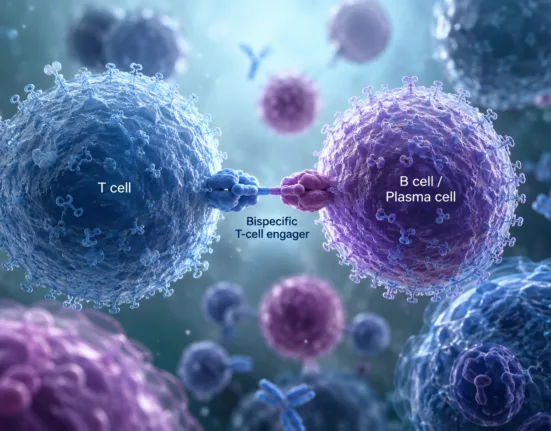
The positioning of tetrahedral antibodies becomes clearer when compared with existing modalities. Bispecific antibodies have gained traction by enabling dual targeting, often combining tumor recognition with immune activation. At the same time, cellular therapies such as chimeric antigen receptor T-cell treatments have demonstrated high efficacy but remain constrained by manufacturing complexity and cost.
Biomolecular Holdings LLC’s platform appears to bridge these categories. By increasing valency and enabling multispecific interactions, tetrahedral antibodies aim to replicate aspects of cellular therapy function while retaining the scalability of biologics. Industry observers suggest that this could be particularly relevant in indications where cell therapies are effective but difficult to deploy widely.
The focus on innate immune engagement further differentiates the platform. Many bispecific antibodies rely on T-cell activation, whereas tetrahedral constructs may engage natural killer cells and monocytes more directly. This could provide an alternative pathway in settings where T-cell responses are limited or exhausted.
Even so, the success of this strategy will depend on demonstrating clear advantages over existing options. The immunotherapy landscape is increasingly crowded, and incremental improvements in efficacy or convenience may not be sufficient to drive adoption without compelling clinical data.
What clinical development pathways, trial design strategies, and endpoint expectations could determine whether tetrahedral antibody platforms translate into regulatory traction
From a regulatory perspective, tetrahedral antibodies fall within established biologics pathways but introduce additional considerations due to their structural novelty. Early clinical trials will need to focus on safety and dose optimization, particularly given the potential for increased immune activation.
Regulatory watchers suggest that careful characterization of cytokine responses and off-target effects will be essential. Higher-order constructs have historically faced challenges in balancing potency with tolerability, and demonstrating a manageable safety profile will be critical for progression into later-stage trials.
Efficacy endpoints will depend on indication but are likely to include tumor response measures in oncology and disease activity or remission in autoimmune conditions. The concept of an immune reset implies durable outcomes, which may require extended follow-up to validate.
Trial design will also be important. Demonstrating meaningful differentiation relative to existing therapies will require appropriate comparators and patient selection. The breadth of the platform suggests multiple development programs may be needed, increasing both opportunity and execution complexity.
What manufacturing scalability and commercial viability questions could define the platform’s long-term impact on biologics markets
Commercial viability will depend not only on clinical success but also on manufacturability. Biomolecular Holdings LLC positions the platform as compatible with monoclonal antibody production processes, which could offer advantages over more complex modalities. However, increased structural complexity may still introduce challenges in expression, purification, and stability.
Industry observers note that manufacturing consistency is critical for both regulatory approval and market adoption. Any variability could affect scalability and cost, particularly in indications requiring long-term treatment.
Reimbursement dynamics will also shape adoption. Therapies that demonstrate deeper or more durable responses may justify higher pricing, but this will depend on robust clinical and economic evidence. In competitive markets, incremental improvements may not be sufficient to drive widespread uptake.
What clinicians, regulators, and industry observers will monitor as tetrahedral antibody programs progress toward clinical validation
As Biomolecular Holdings LLC advances its platform, attention will focus on early clinical signals that can validate or challenge the underlying hypothesis. Observers will be watching for evidence that increased valency and dual Fc engagement translate into improved outcomes without disproportionate safety risks.
The adaptability of the platform across multiple targets will also be a key indicator of its long-term potential. A single successful program could validate the approach, but a diversified pipeline would strengthen its position as a foundational technology in antibody engineering.
At a broader level, the development of tetrahedral antibodies reflects a continuing shift toward more complex and multifunctional biologics. As the industry moves beyond traditional monoclonal formats, the ability to engineer precise interactions between targets and immune effectors is becoming a central theme. Biomolecular Holdings LLC’s patent position suggests that it intends to play a significant role in shaping that trajectory, but the ultimate impact will depend on execution across clinical, regulatory, and commercial dimensions.