Aztron Medtech Corporation has added two milestones to its effort to establish the TendMIN minimally invasive Achilles tendon repair system in the United States, with its Taiwan subsidiary Astron Medtech Co., Ltd. receiving a Presidential Award under Taiwan’s National Development Council startup competition while U.S. TendMIN procedures have now exceeded 200. The privately held orthopedic device developer also expects to pursue another financing round later in 2026, making the next phase less about winning recognition and more about whether early procedural adoption can be converted into a scalable commercial business.
The official National Development Council record provides useful context for the award. The 2026 competition attracted 2,805 entrepreneurial teams, with Astron Medtech among three companies receiving the Presidential Award and NT$10 million in startup support, rather than a single winner emerging from the field. The award followed a nine-month selection process and adds non-dilutive capital and government recognition to a company that is simultaneously investing in surgeon relationships, clinical evidence and U.S. commercialization.
The more commercially important number, however, may be the 200 U.S. procedures. Aztron reported only 50 TendMIN procedures across 15 U.S. hospitals and surgical centers in August 2025, passed 100 procedures by February 2026 and has now moved beyond 200, showing continued utilization rather than a pilot programme that stalled after a small number of early adopters. The absolute base nevertheless remains modest for a nationwide surgical-device business, and the company has not disclosed how many institutions account for the latest 200 procedures or how concentrated usage is among its most active surgeons.
What does Taiwan’s Presidential Award really add to Aztron Medtech’s U.S. expansion strategy?
For Aztron Medtech, the Presidential Award matters less as a clinical endorsement than as an additional source of capital and institutional credibility at a point when the company is moving from product introduction toward repeat commercial use. Taiwan’s National Development Council described Astron Medtech as a developer of minimally invasive tendon-repair technology capable of reducing incision size to around one centimeter, while the competition was designed partly to connect promising startups with longer-term government, investment and international expansion resources.
That distinction is important because an innovation award cannot substitute for surgeon adoption, clinical evidence or hospital purchasing decisions in the United States. Its practical value lies in extending the resources available to a still relatively small orthopedic company while providing another credibility signal as Aztron engages distributors, surgeons and prospective investors.
Aztron says it has received about $4 million of funding across financing completed in 2022 and 2025, including a $2.5 million Seed+ round announced last year. Management now expects another financing later in 2026 to support product development, U.S. commercial expansion and international growth.
That planned financing may ultimately tell investors and industry observers more about Aztron’s commercial trajectory than the NT$10 million award itself. Selling a disposable or procedure-based orthopedic technology requires continuing expenditure on surgeon education, distribution, inventory, clinical support and evidence generation, particularly when the product asks surgeons to incorporate a specific percutaneous technique and, in some cases, ultrasound guidance into their workflow.
Does crossing 200 TendMIN procedures represent adoption or only an early commercial foothold?
The procedural progression provides encouraging evidence of continued use. Aztron had completed 50 U.S. TendMIN procedures across 15 hospitals and surgical centers by August 2025, reached more than 100 by February 2026 and has now surpassed 200, meaning at least another 100 procedures were performed during the roughly six months following the February milestone.
That trajectory is more meaningful than an isolated first-case announcement because it demonstrates that the device has continued to enter operating rooms after its initial pilot phase. Still, procedure counts do not reveal whether adoption is broad or deep. Two hundred procedures distributed evenly across dozens of surgeons would tell a different commercial story from 200 procedures concentrated among a small core of enthusiastic users, and Aztron’s latest disclosure does not provide enough information to distinguish between those scenarios.
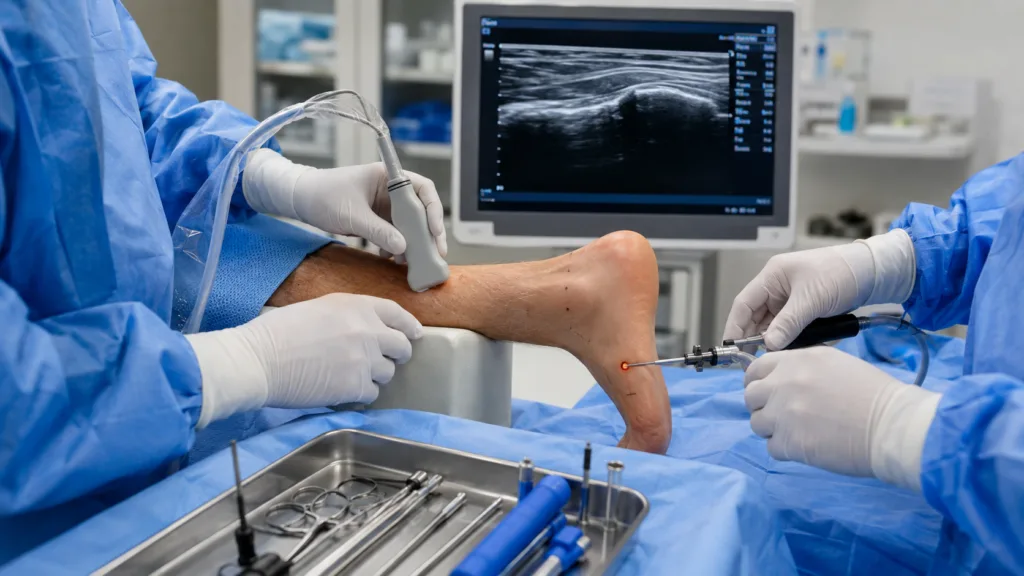
TendMIN combines a grasper and telescoping needle intended to facilitate percutaneous Achilles tendon repair and suture placement through incisions of around one centimeter or less. Aztron also promotes ultrasound-guided use to help surgeons visualize tendon structures and guide placement, while the system can support different suture and fixation configurations.
The company has also widened its potential purchasing channels. Through Lovell Government Services, TendMIN was placed on the Federal Supply Schedule, Defense Logistics Agency Electronic Catalog and GSA Advantage in 2025, giving eligible Department of Defense and Department of Veterans Affairs facilities established procurement routes for the product. Those listings reduce an administrative barrier to federal purchasing, but they should not be confused with guaranteed procedure volumes or contracts requiring hospitals to use the system.
Commercially, the next useful disclosure would therefore be less about another round-number procedure milestone and more about the quality of adoption: number of active institutions, repeat-order rates, procedures per trained surgeon, distributor productivity and whether the company is expanding beyond early specialist champions.
How strong is the clinical evidence behind the minimally invasive Achilles repair proposition?
The broader clinical rationale for minimally invasive Achilles tendon repair is credible, but the evidence does not support treating every minimally invasive technique as automatically superior to open repair. A 2025 umbrella review drawing on systematic reviews and meta-analyses found broadly comparable effectiveness between minimally invasive and open approaches, with potential advantages for minimally invasive surgery in some complication and recovery outcomes but continuing concern over nerve injury depending on technique and operator experience.
Another 2025 meta-analysis comparing mini-open and percutaneous techniques found lower rerupture and sural nerve injury rates with mini-open repair in the studies it examined, illustrating why incision size alone cannot determine clinical value. Surgical technique, suture placement, visualization, rehabilitation strategy and surgeon experience can materially influence outcomes.
Aztron frequently references a 2012 peer-reviewed study of ultrasound-guided minimally invasive Achilles repair that included 23 patients treated with the minimally invasive technique and 25 patients undergoing conventional open repair. The study reported an average wound size of 1.1 centimeters, comparable postoperative functional scores and statistically favorable results for several complications in the minimally invasive group, but it was a Level III comparative case series involving a single surgeon and was explicitly presented as preliminary research.
That study supports the biological and procedural rationale for ultrasound-guided repair, but it is not equivalent to a large prospective multicenter clinical trial specifically validating TendMIN across diverse U.S. practices. Aztron’s own website currently supplements the published literature with physician white papers and individual clinical cases involving TendMIN, which may help communicate technique and real-world experience but remain a different level of evidence from controlled multicenter research.
This is where the 200-procedure milestone can become strategically valuable. If Aztron uses its expanding procedure base to build systematically collected multicenter outcomes covering rerupture, infection, sural nerve injury, functional recovery, procedure time and return to activity, commercial experience could gradually develop into a stronger evidence package. Without that progression, increasing case numbers mainly demonstrate utilization rather than comparative clinical benefit.
Why does Aztron Medtech’s FDA terminology deserve particular attention as TendMIN scales?
There is an important regulatory terminology issue surrounding TendMIN. Aztron’s August 19 announcement describes the TendMIN system as FDA-cleared, while multiple earlier Aztron disclosures, including its August 2025 and February 2026 procedure announcements, described TendMIN as FDA-listed.
Those terms are not interchangeable. The United States Food and Drug Administration explains that 510(k) clearance involves a determination that a device is substantially equivalent to a legally marketed predicate device, whereas establishment registration and device listing are separate regulatory concepts. A TendMIN-specific 510(k) decision was not identified in the FDA’s releasable 510(k) database during this review, so the more cautious editorial approach is to avoid treating the latest wording as independently verified 510(k) clearance unless Aztron provides the applicable submission number or other regulatory documentation.
The distinction does not erase TendMIN’s real-world U.S. use or the significance of more than 200 reported procedures. It does matter, however, when assessing regulatory de-risking and describing what level of FDA review the product has undergone, particularly as Aztron increases its visibility with hospitals, government health systems and new investors.
What will determine whether TendMIN moves from early traction to a scalable orthopedic platform?
Aztron now has several pieces of an emerging commercial story: a product being used in U.S. procedures, an expanding surgeon network, federal procurement access, government recognition in Taiwan and plans for additional financing. The company is also positioning TendMIN as the foundation of a broader sports medicine and foot-and-ankle platform rather than a single narrowly commercialized instrument.
What remains unproven is scale. Crossing 200 procedures establishes that TendMIN has moved beyond experimental commercialization, but it does not yet demonstrate whether Aztron can generate predictable recurring demand across a large and growing base of hospitals and ambulatory surgery centers.
The next financing round will therefore arrive at a useful inflection point. Prospective investors can now examine more than a prototype and a regulatory strategy; they can evaluate actual U.S. procedure growth, surgeon adoption and an emerging distribution footprint. At the same time, they are likely to want clearer regulatory documentation, stronger multicenter clinical evidence and visibility into how efficiently Aztron can convert additional commercial spending into repeat procedure volume.
The Presidential Award gives Aztron Medtech another source of momentum, but TendMIN’s more consequential test is already taking place in U.S. operating rooms. If the company can turn its first 200 procedures into repeat institutional purchasing, broader surgeon adoption and stronger outcomes data, the current milestones could mark the beginning of a genuinely scalable orthopedic-device franchise rather than simply a successful early launch.