
Revance and Teoxane have announced the US commercial introduction of RHA Redensity Eye following Food and Drug Administration Premarket Approval for correction of moderate to severe tissue-volume deficiencies in the infraorbital region of adults aged 22 years and older, giving the Teoxane RHA Collection an indication specifically addressing undereye hollows. While the companies announced the development on August 20, FDA records show the underlying PMA supplement, P170002/S050, was approved on May 12, 2026, an important date distinction for the regulatory record.
The product is a Class III aesthetic dermal implant rather than a pharmaceutical approval. FDA describes RHA Redensity Eye as a sterile, biodegradable hyaluronic acid gel intended for injection into the sub-dermis and supraperiosteum, while its approval conditions require a device-specific provider training programme focused on facial anatomy, vascular structures, injection technique and management of potential intravascular complications.
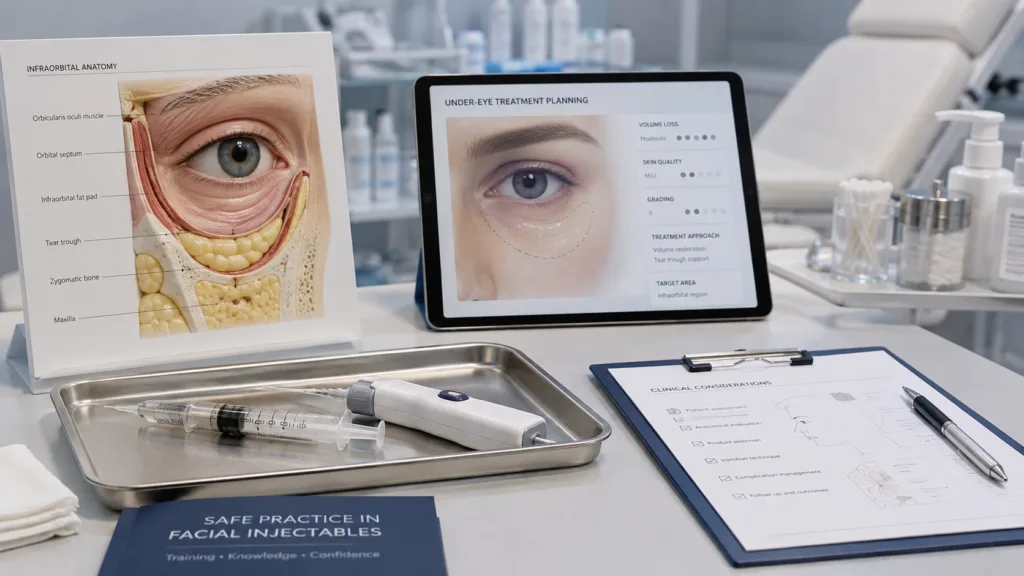
That requirement is clinically meaningful because the infraorbital area combines thin soft tissue, visible facial movement and proximity to important vascular anatomy. The aesthetic opportunity is substantial, but so is the consequence of improper filler placement, making injector technique an integral part of the product’s real-world safety profile rather than a peripheral commercial consideration.
What exactly did FDA approve for RHA Redensity Eye?
FDA approved Teoxane’s PMA supplement to expand use of RHA Redensity Eye and RHA Redensity Eye Lido into correction of moderate to severe tissue-volume deficiencies in the infraorbital region. The product can be injected into the sub-dermal plane and supraperiosteal plane in adults aged 22 years or older.
RHA Redensity Eye is a viscoelastic gel containing both crosslinked and non-crosslinked sodium hyaluronic acid at a concentration of 15 mg/g. The version labeled RHA Redensity Eye contains 0.3% mepivacaine hydrochloride to reduce injection pain, while the clinically evaluated RHA Redensity Eye Lido formulation uses 0.3% lidocaine. FDA concluded that similarities between the formulations allowed the US clinical evaluation of the lidocaine-containing product to support the infraorbital indication for both versions.
The product is classified under FDA product code LMH as an aesthetic dermal implant and is treated as a Class III device. The approval therefore came through a PMA supplement rather than a 510(k) substantial-equivalence clearance, reflecting a regulatory framework requiring FDA review of evidence providing reasonable assurance of safety and effectiveness for the expanded indication.
FDA established shelf lives of 36 months for RHA Redensity Eye Lido and 24 months for RHA Redensity Eye under recommended storage conditions up to 25 degrees Celsius. The agency also imposed annual reporting requirements covering distribution volumes and ongoing adverse-event assessment.
What did the pivotal US study show in patients with undereye hollows?
The approval was supported by study TEO-RHA-1902, a prospective, randomized, evaluator-blinded, multicenter clinical study comparing RHA Redensity Eye Lido with no treatment in people with moderate to severe infraorbital volume deficiency. Revance and Teoxane reported that 93% of treated patients demonstrated aesthetic improvement at three months and that treatment effects persisted for as long as 12 months without touch-up procedures.
The safety population included 233 treated participants, divided almost evenly between needle and blunt-tip cannula administration. FDA labeling shows that tenderness, swelling, bruising, lumps or bumps and firmness were among the most frequently reported common treatment responses. Nearly 70% of participants experienced a response lasting between one and three days, while more than 70% of all recorded responses had resolved within seven days.
Approximately 18.8% of participants recorded no common treatment response at all. Among the responses that did occur, more than 94% reached a maximum severity of mild or moderate, while fewer than 5% of subjects reported a response categorized as severe.
Injection technique produced some noticeable differences. At least one common treatment response was reported by 89.1% of patients injected with a needle compared with 73.5% of those treated using a cannula. Bruising occurred in 71.8% of needle-treated participants versus 38.1% of those treated with a cannula, while redness occurred in 49.1% versus 23.0%, respectively.
These numbers do not establish that a cannula is superior in every clinical circumstance because choice of instrument, treatment plane and technique can depend on anatomy and injector preference. They do, however, provide useful evidence that administration method can influence short-term local reactions.
The companies also reported no late-onset or serious treatment-related adverse events in the pivotal study, no treatment-related granulomas or delayed inflammatory responses and no observed vascular occlusion.
Why did FDA make injector training a condition of approval?
The absence of vascular occlusion in a controlled clinical study does not eliminate the known vascular risk of facial fillers.
FDA labeling warns that inadvertent injection into a blood vessel can result in embolization, vascular occlusion, ischemia or infarction. Rare but serious consequences reported with facial soft-tissue fillers as a class include temporary or permanent visual impairment, blindness, cerebral ischemia or hemorrhage leading to stroke, skin necrosis and injury to underlying facial structures.
Those risks are particularly relevant around the eye because facial arteries can communicate with the ophthalmic circulation. A filler product can therefore have a favorable trial-level safety profile while still requiring extensive procedural risk management in routine aesthetic use.
FDA addressed that issue directly through post-approval conditions. Teoxane must develop and maintain device-specific training covering facial anatomy and vasculature, safe injection methods and recognition and management of complications, including intravascular events. The programme must receive FDA approval and be implemented within six months of the May approval date.
More unusually, FDA states that the manufacturer may distribute the product only to providers who have successfully completed the device-specific training programme. Teoxane must also provide annual reports on the programme, including the number of trained providers and quantitative measures of its effectiveness, and FDA recommends developing a method for the public to verify whether a practitioner has completed the required training.
That makes professional education part of the regulatory architecture of the product rather than merely a voluntary manufacturer initiative.
What differentiates RHA Redensity Eye from another hyaluronic acid filler?
Teoxane’s RHA technology is based on what it calls Preserved Network Technology, a manufacturing approach intended to limit modification of the original hyaluronic acid polymer network while producing a gel capable of adapting to facial movement. The company positions Redensity Eye as having rheological properties suited to the thin and mobile infraorbital region.
Marketing descriptions around dynamic strength, stretch and natural movement are commercially relevant but need to be separated from the actual FDA indication. The authorized claim is correction of moderate to severe volume deficiencies in the infraorbital region; FDA approval does not establish that the filler is aesthetically superior to every competing product or that one manufacturing technology necessarily produces better results in every patient.
The clinical design does provide one unusual evidence element. Revance and Teoxane said RHA Redensity Eye became the first hyaluronic acid gel for the infraorbital region to demonstrate effectiveness using patient-reported outcomes as a co-primary endpoint in a US pivotal study.
Patient-reported outcomes are particularly relevant in aesthetic medicine because the intended benefit is ultimately perceptual rather than treatment of an underlying disease. Investigator grading can establish visible anatomical correction, but whether patients themselves perceive meaningful improvement adds a different dimension to effectiveness.
The reported durability of up to 12 months without touch-ups could also influence the commercial proposition. Filler longevity affects treatment frequency, cost and convenience, although individual duration can vary according to anatomy, metabolism, injection volume and other factors.
Why is the undereye region becoming a more competitive aesthetic category?
The infraorbital region is one of the most technically challenging areas of facial rejuvenation because apparent hollowness can arise from different combinations of skeletal structure, soft-tissue loss, fat position, skin quality and aging.
That means not every patient who dislikes the appearance of the undereye area is an appropriate filler candidate. FDA labeling specifically notes that safety and effectiveness have not been established for treatment of excessive orbital fat prolapse, excessive lower-eyelid skin laxity, ectropion or entropion.
Patient selection is therefore as important as the injectable material. Adding filler volume to the wrong anatomical problem can fail to improve appearance and may accentuate puffiness or contour irregularities.
Revance also linked the launch to growing discussion of facial changes among patients losing substantial amounts of weight, including people using GLP-1-based obesity treatments. The undereye region can lose visible volume during major weight reduction, although the FDA indication is based on anatomical tissue-volume deficiency and is not specifically an indication for changes caused by GLP-1 therapy.
The expanding use of weight-management medicines could nevertheless increase the number of patients seeking facial-volume correction, creating a new commercial tailwind for established aesthetic categories.
What will determine whether RHA Redensity Eye gains meaningful US adoption?
FDA approval resolves the regulatory question but simultaneously raises the operational importance of training.
Revance and Teoxane cannot simply distribute RHA Redensity Eye across the entire injector market without complying with the device-specific education conditions attached to the PMA. Provider qualification therefore becomes a built-in pacing factor for commercial rollout.
That could have advantages. A controlled launch through appropriately trained practitioners may reduce complications and protect confidence in the product, particularly in an anatomical region where vascular events can be catastrophic.
The other determinant will be real-world performance. The pivotal study reported 93% aesthetic improvement at three months and durability through 12 months without touch-ups, but practitioners will judge how predictably those results translate across different facial anatomies, injection techniques and previous-treatment histories.
Teoxane and Revance are entering this market with more than a new syringe configuration. FDA has effectively tied the expanded indication to a combination of product characteristics, anatomical knowledge and procedural competence.
That makes RHA Redensity Eye an interesting medical-device launch for a reason rarely captured in aesthetic marketing. The regulatory value is not simply that FDA has allowed treatment of undereye hollows. It is that the agency has made specialized training part of the conditions under which the product can be distributed, underscoring how closely the effectiveness and safety of an injectable implant can depend on the hands delivering it.