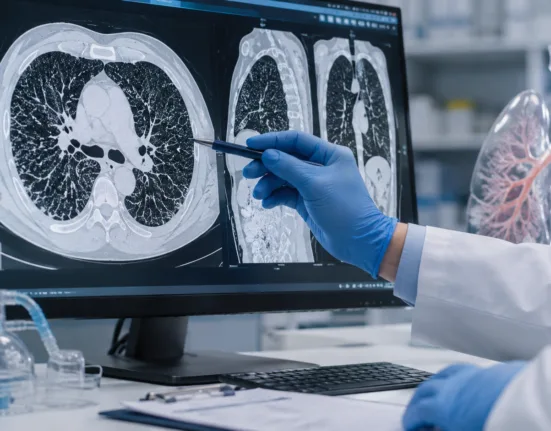
Vascudyne has published long-duration preclinical evidence showing that an externally supported, acellular tissue-engineered blood vessel remained open for as long as 550 days after implantation as a coronary artery bypass graft, including approximately one year after anticoagulation had been discontinued. The Nature Communications study, published August 21, 2026, is important because small-diameter synthetic vascular grafts have historically struggled in coronary circulation, where thrombosis and poor biological integration can rapidly compromise an implanted conduit. Vascudyne’s 4-millimeter vessel instead showed 100% patency at 180 days among externally supported grafts and evidence that host cells had repopulated the structure into living vascular tissue.
The findings remain preclinical and were generated in an ovine model, so they do not establish long-term safety or patency in humans. Vascudyne has nevertheless already moved the technology into a first-in-human coronary bypass feasibility programme, with JACC: Case Reports describing three patients and two technically successful implants after an initial length-mismatch problem informed modifications in procedural planning. The combination of human feasibility and unusually long animal follow-up makes the technology more clinically relevant than an early laboratory scaffold while leaving the decisive efficacy evidence ahead.
Why is finding a reliable coronary bypass graft still a problem after decades of CABG surgery?
Coronary artery bypass grafting depends on creating a new pathway around blocked coronary arteries, usually using a patient’s internal mammary artery or veins harvested from the leg. Arterial grafts can provide excellent long-term performance, but surgeons often need additional conduits when several vessels require bypass, leaving saphenous veins as an important source.
Veins are not designed for the high-pressure arterial environment and can develop intimal hyperplasia, atherosclerosis and eventual occlusion after transplantation. Their quality also varies substantially between patients, particularly among people with diabetes, peripheral vascular disease, venous disease or previous bypass surgery.
Harvesting adds another surgical site, increasing operative time and creating the possibility of wound infection, pain and healing problems. These limitations create a long-standing rationale for an off-the-shelf graft that could be opened in the operating room without depending on whether the individual patient has usable vessels.
Synthetic materials have worked much better in larger-diameter vascular applications than in small coronary arteries because slower blood flow and the thrombogenic surface of synthetic grafts can promote clotting. Vascudyne is trying to solve that problem with biological tissue rather than conventional permanent synthetic tubing.
How is Vascudyne’s vessel manufactured if it does not come from the patient?
The company’s technology begins with cells grown around a tubular scaffold in a controlled manufacturing process. Those cells produce an extracellular matrix rich in biological structural proteins, after which the original cells are removed, leaving an acellular tissue-engineered vessel that can theoretically be stored and implanted in different recipients without carrying the same immunological burden as viable donor tissue.
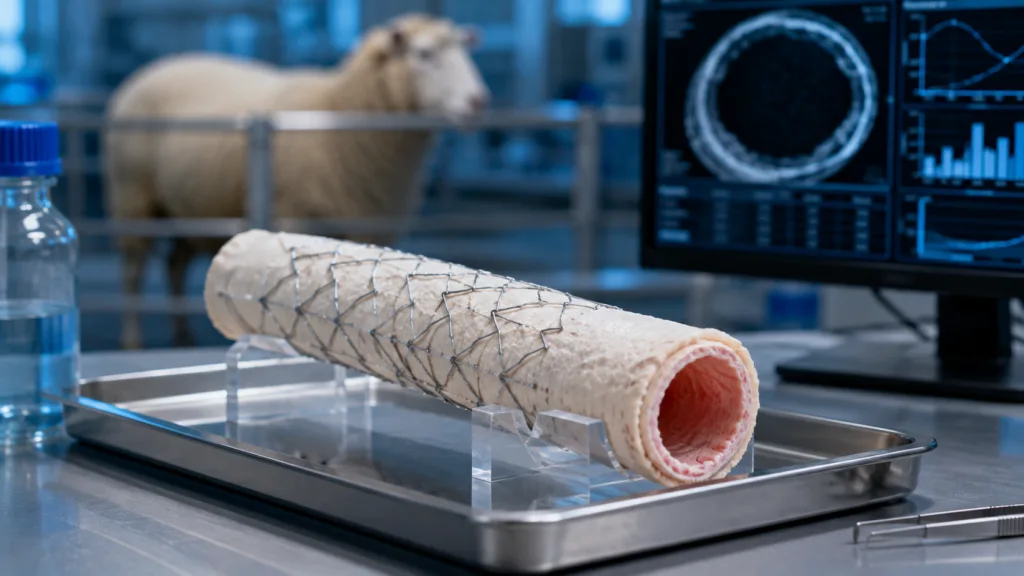
In the coronary study, Vascudyne added a laser-cut nitinol external support around the vessel. This apparently simple mechanical component proved critical: unsupported grafts failed early because kinking led to thrombosis, whereas externally supported vessels maintained their geometry sufficiently to remain patent.
The externally supported grafts achieved 100% patency at 180 days. Two animals were then followed to 550 days, with anticoagulation stopped at day 180 and not resumed. The grafts remained patent throughout that additional year, providing a particularly interesting result because reliance on permanent systemic anticoagulation would substantially weaken the commercial appeal of an otherwise ready-to-use coronary conduit.
Did the implanted graft remain an artificial structure or become living tissue?
Histological analysis suggests substantial biological remodeling. The explanted conduits developed an endothelial lining, became repopulated by smooth-muscle cells, showed minimal inflammatory reaction and were free of thrombus. Mechanical testing also found burst pressure exceeding native coronary bypass graft tissue evaluated in the study.
This regenerative behavior is central to Vascudyne’s value proposition. A permanent synthetic tube remains foreign material and must resist thrombosis and mechanical failure throughout its lifetime, whereas an acellular biological matrix can potentially become integrated with the recipient’s own cells and gradually behave more like native tissue.
The phrase “regenerated into the patient’s own blood vessel” should nevertheless be used carefully. The animal study demonstrates host-cell repopulation and biological remodeling, but it does not establish that the graft becomes indistinguishable from a native human artery or that remodeling will proceed identically in patients with diabetes, advanced vascular disease or severe systemic inflammation.
What have the first human implants shown so far?
Vascudyne’s early coronary artery bypass feasibility programme has moved the graft into humans, but the evidence remains exceptionally small. The first-in-human report involved three patients undergoing multivessel CABG. One intended implant encountered a length mismatch, after which CT-based three-dimensional modeling was introduced to improve sizing, and two subsequent grafts were successfully implanted.
The early report described procedural feasibility and device safety with 12-month follow-up under a standard direct oral anticoagulant regimen. This is an important milestone because a vascular graft that performs well in sheep can still fail when confronted with human anatomy, surgical handling, coronary flow and disease. However, two successful implanted grafts cannot establish patency rates, comparative effectiveness or uncommon complications.
The animal experiment therefore fills a different evidence gap. It allows researchers to remove grafts after long follow-up and examine their structure directly, something that cannot be performed routinely in living human recipients. Together, the studies provide complementary evidence, but a larger prospective clinical trial will ultimately be required before the technology can challenge autologous vessels in routine CABG.
Which patients would benefit most if an off-the-shelf coronary graft works?
The first commercial opportunity may not be replacing every saphenous vein. It may instead involve patients with poor or unavailable native conduit, where surgeons currently face the most difficult compromises. Older patients, people with extensive peripheral vascular disease and individuals undergoing repeat bypass surgery can have particularly limited graft options.
An off-the-shelf biological vessel could also eliminate the secondary incision used to harvest a vein, which may be particularly valuable for patients at high risk of poor wound healing. Standardized manufacturing could potentially reduce variability in conduit quality, allowing surgeons to know the dimensions and mechanical properties before beginning the procedure.
Those benefits will matter only if coronary patency is durable. Bypass surgery is performed partly because it can deliver years of blood flow around complex coronary disease, meaning a replacement conduit must ultimately be judged over long periods rather than by successful implantation alone.
Vascudyne’s 550-day animal data are therefore meaningful precisely because they push beyond early feasibility. They show that an engineered 4-millimeter conduit can remain open in the coronary circulation after anticoagulation is withdrawn and undergo substantial biological remodeling. The next challenge is much harder: demonstrating that the same behavior persists across enough human patients and enough years to justify placing a manufactured vessel where surgeons currently prefer the patient’s own tissue whenever possible.