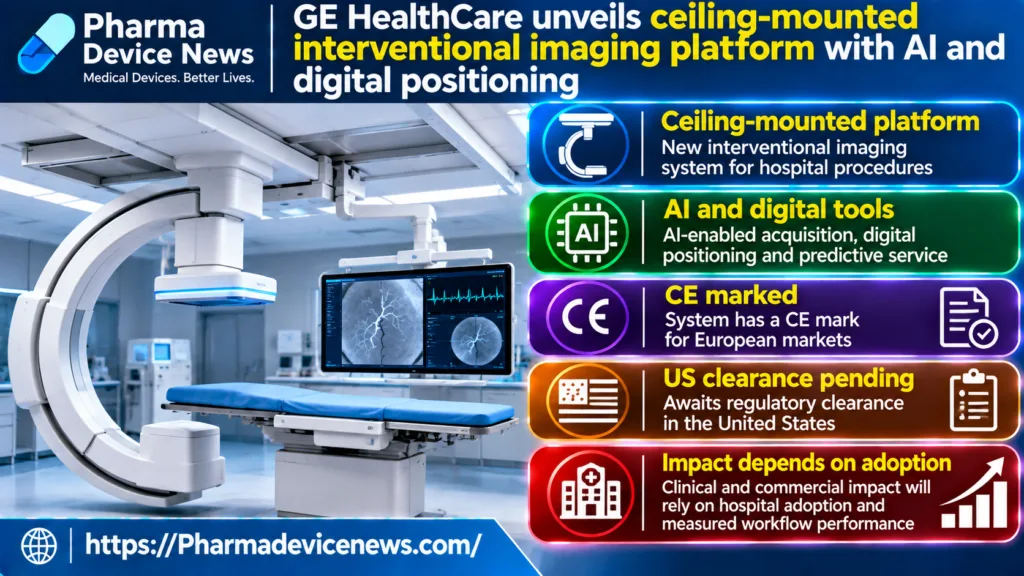
GE HealthCare Technologies Inc. (NASDAQ: GEHC) has introduced Allia Celeo, a ceiling-mounted interventional imaging system combining artificial intelligence-enabled image acquisition, digital positioning assistance and predictive maintenance technology for cardiovascular and interventional radiology procedures. Unveiled on November 1, 2026, at the Transcatheter Cardiovascular Therapeutics conference in San Diego, the platform is designed to improve movement around the patient, simplify equipment positioning and support consistent imaging across different procedures.
The new system extends GE HealthCare’s Allia portfolio beyond its existing configurations, incorporating an extra-wide-bore C-arm, integrated cabling and a digital representation of the imaging system to help clinical teams plan positioning. Its AI-enabled imaging chain is designed to adjust acquisition parameters according to clinical requirements while balancing image quality and radiation dose. The platform also supports integration with selected cardiac, vascular and interventional oncology applications.
However, the regulatory distinction is important. Allia Celeo has received European CE marking, but its United States Food and Drug Administration 510(k) submission remains pending, and the system is not available for sale in the United States. GE HealthCare has not disclosed pricing, confirmed installations, customer orders or quantitative clinical evidence establishing that the new platform reduces procedure duration or radiation exposure compared with alternative systems.
Why is GE HealthCare introducing Allia Celeo into the interventional imaging market?
Interventional cardiology and radiology increasingly rely on sophisticated image guidance to perform minimally invasive procedures through small vascular access points. These interventions can require repeated imaging, repositioning of equipment and coordination among physicians, nurses, technologists and other specialists. The physical arrangement of the room can therefore influence procedural efficiency as well as the clinical team’s ability to access the patient.
GE HealthCare has developed Allia Celeo around the concept of maintaining procedural flow, with an emphasis on adapting equipment movement to different procedures and anatomical requirements. Unlike systems designed exclusively around one particular intervention, the new platform is intended to support a broad range of cardiovascular and non-cardiovascular applications. This flexibility may be relevant to hospitals operating interventional suites that accommodate several clinical specialties.
Jyoti Gera, chief executive officer of CardioVascular and Interventional Solutions within GE HealthCare’s Advanced Imaging Solutions business, has described the launch as part of a strategy to provide hospitals with greater flexibility in configuring their interventional environments. Management is seeking to combine image quality, equipment positioning and software integration within a single platform. However, these advantages remain primarily design objectives until they are supported by comparative operational evidence.
The broader commercial rationale involves improving the efficiency of expensive hospital facilities. Interventional suites require substantial capital expenditure, specialist staffing and carefully coordinated procedure schedules. Equipment that reduces unnecessary repositioning or interruptions could potentially improve utilisation, but the economic benefit will depend on measurable changes in actual hospital workflows.
How could Allia Celeo’s ceiling-mounted C-arm improve access during complex procedures?
Allia Celeo uses a slim, symmetrical ceiling-mounted gantry with integrated cabling and an extra-wide-bore configuration. The design is intended to create additional space around the patient and reduce obstacles that can interfere with staff movement or equipment placement. This is particularly relevant during procedures requiring several clinicians, imaging devices and monitoring systems to operate simultaneously.
GE HealthCare says the C-arm can rotate around the patient and reach steep imaging angles, including in cases involving individuals with a higher body mass index. Such flexibility may be useful when obtaining anatomical views that would otherwise require repositioning the patient or making more substantial changes to the room setup. The company’s design also incorporates a slim detector lift intended to improve visibility among team members.
A ceiling-mounted architecture introduces different considerations from floor-mounted imaging equipment. Removing certain floor-based components can potentially create additional working space, while overhead positioning can support movement across the procedural table. However, the most suitable configuration depends on room dimensions, clinical requirements and the location of other equipment.
The announcement does not specify the gantry’s exact angular range, bore dimensions or comparative positioning times. These details would help hospitals evaluate whether the system offers meaningful advantages over existing installations. The benefits must also be considered alongside installation requirements and the practicality of accommodating ceiling-mounted equipment within an established facility.
For potential customers, the central question is whether greater physical flexibility translates into safer and more efficient procedures. Improved access can support clinical work, but the announcement does not establish that Allia Celeo reduces complications or improves patient outcomes.
What does the digital twin actually do during Allia Celeo imaging procedures?
Allia Celeo includes an on-screen digital representation of the gantry and its positioning, which GE HealthCare describes as a digital twin. The feature is intended to help operators anticipate and optimise equipment movement before positioning the system for imaging. Rather than requiring staff to rely exclusively on direct visual assessment of the equipment, the interface provides an additional digital view of its configuration.
The functionality could be useful during procedures involving repeated transitions between imaging positions. Clinicians may need to obtain several projections of complex vascular or cardiac anatomy, while other equipment remains positioned near the patient. A clearer understanding of gantry movement could help reduce unnecessary adjustments.
The system also allows operators to control table and gantry positioning from multiple locations. Personalised controls and layouts are intended to support different working preferences and procedural requirements. These features may reduce the need for clinicians to move repeatedly between control points during an intervention.
However, the term digital twin should not be interpreted as evidence that Allia Celeo provides a complete patient-specific simulation of the anatomy or predicts the clinical consequences of a procedure. The announced feature primarily concerns equipment positioning and workflow support. It is not described as an autonomous treatment-planning system.
A meaningful evaluation would measure positioning time, workflow interruptions and operator satisfaction under comparable conditions. GE HealthCare has not disclosed those results for Allia Celeo. Its potential advantage is therefore plausible from the design but remains to be quantified in clinical operation.
How does AI-powered image acquisition balance radiation dose and diagnostic visibility?
Fluoroscopy and related X-ray imaging techniques provide real-time visual information during many cardiovascular and radiological interventions. The quality of these images depends on factors including patient anatomy, image acquisition settings and the amount of radiation used. Maintaining adequate visibility while limiting unnecessary exposure is an important objective for both patients and clinical staff.
Allia Celeo incorporates an AI-enabled imaging chain intended to adjust acquisition parameters automatically according to the imaging task. GE HealthCare says the system is designed to maintain consistent image quality while using the lowest radiation dose appropriate to the acquisition. The platform also includes advanced rendering options for cardiac imaging that can be selected according to operator preferences.
The technical approach could reduce the need for repeated manual adjustments when imaging conditions change. For example, differences in patient size or anatomical complexity may require modifications to acquisition settings. An automated system could potentially help maintain visual consistency while reducing the burden on the operator.
However, automatic optimisation does not eliminate radiation exposure, and the company has not established a numerical dose reduction in the announcement. Claims about lower dose require careful consideration of the imaging task, comparator system, patient population and measurement method. A system that produces better images under particular conditions may not necessarily reduce total radiation across every procedure.
The performance of the image-processing algorithms will also matter. Excessive noise reduction or image enhancement could obscure subtle anatomical details if not appropriately validated. Clinical teams therefore need confidence that automated adjustments preserve information relevant to treatment decisions.
Allia Celeo’s AI functionality should be understood as supporting image acquisition and rendering rather than independently diagnosing disease or directing treatment. Physicians remain responsible for interpreting images and making procedural decisions.
Why could integration with existing cardiac and interventional radiology software support hospital adoption?
GE HealthCare designed Allia Celeo to work with selected technologies already used during cardiovascular and interventional radiology procedures. In coronary interventions, compatible applications include StentViz and 3DStent for stent visualisation, along with Valve ASSIST 2 for structural heart planning. The platform also supports the cleared Mac-Lab haemodynamic system, including fractional flow reserve and diastolic pressure ratio measurements.
These applications address different stages of procedural assessment. Stent visualisation may help operators assess the positioning of coronary implants, while haemodynamic measurements provide information about the physiological significance of coronary artery disease. Structural heart planning tools can assist with image interpretation during selected valve procedures.
For interventional radiology and oncology, the system is designed to work with applications including Embo ASSIST AI, Vessel ASSIST and Needle ASSIST. These technologies support tasks such as embolisation planning, vascular roadmapping and needle guidance. Allia Celeo can also integrate selected third-party intravascular imaging and physiology systems.
This interoperability could be commercially relevant because hospitals often have substantial investments in existing diagnostic and procedural equipment. A new imaging platform that accommodates familiar software may reduce some of the practical barriers associated with replacement or expansion. Nevertheless, successful integration depends on specific product versions, compatibility requirements and local implementation.
The company has clarified that applications may be sold separately and may not be available in every market. Compatibility with a cleared application does not mean that all software functions are automatically included in the base system. Hospitals will therefore need to assess the complete configuration and associated costs before purchasing.
How could OnWatch Predict change the maintenance economics of interventional imaging equipment?
Allia Celeo is designed to support OnWatch Predict, GE HealthCare’s remote monitoring and predictive maintenance technology. The system combines continuous equipment monitoring with deep learning-based analytics intended to identify conditions that may lead to unexpected service interruptions. The objective is to support proactive maintenance before a technical problem disrupts scheduled procedures.
Unplanned imaging equipment downtime can create substantial operational consequences for hospitals. Procedures may need to be postponed or transferred to another room, while staff and clinical resources remain underutilised. In departments with high procedural volumes, even relatively short disruptions can affect scheduling and patient access.
Predictive monitoring could potentially help hospitals plan maintenance at less disruptive times. Service teams may be able to investigate developing problems before equipment performance deteriorates significantly. However, the reliability of such systems depends on the quality of monitoring data and their ability to distinguish genuine failure risks from harmless variations.
GE HealthCare has not provided Allia Celeo-specific evidence quantifying reductions in equipment downtime or maintenance expenditure. The technology is intended to improve service predictability, but the actual financial benefits will depend on deployment conditions and hospital operations. Predictive analytics also cannot prevent every hardware or software failure.
For healthcare providers, the relevant purchasing calculation extends beyond image quality. Equipment availability, service costs and scheduling reliability can materially influence the lifetime economics of an interventional suite. OnWatch Predict may contribute to that assessment, but it should not be treated as proof of a particular return on investment.
What is the regulatory difference between Allia Celeo and the already cleared Allia Moveo?
Allia Celeo has received CE marking under the applicable European regulatory framework, but its US FDA 510(k) submission is still pending. The system is not currently available for sale in the United States, according to the company’s November announcement. This distinction is essential because unveiling a device at a US medical conference does not establish permission to market it domestically.
GE HealthCare’s floor-mounted Allia Moveo has a different regulatory status. The company announced in February 2026 that Allia Moveo had received FDA 510(k) clearance and European CE marking, alongside its first global installation at Hôpital Marie-Lannelongue in France. The manufacturer also identified Baylor St. Luke’s Medical Center in Houston as the first US installation of that system.
The two products address related clinical needs but use different equipment architectures. Allia Moveo emphasises compact floor-mounted movement, while Allia Celeo uses a ceiling-mounted configuration intended to support different room layouts and workflow requirements. Hospitals may therefore select between the systems according to their infrastructure and procedural priorities.
However, FDA clearance of Allia Moveo does not extend automatically to Allia Celeo. The newer product must complete its own applicable regulatory process. Likewise, the regulatory status of compatible software applications should not be confused with clearance of the new imaging system itself.
GE HealthCare has not provided a target date for US clearance or identified its first planned Allia Celeo installation. Those disclosures would offer a clearer indication of when the new platform may contribute to additional markets. Until then, its commercial availability remains geographically restricted.
What does the Allia Celeo launch mean for GE HealthCare’s financial performance and imaging strategy?
GE HealthCare reported third-quarter 2026 revenue of approximately $5.5 billion, representing growth of 7.2% from the previous year. Organic revenue increased 6.2%, while organic orders grew 4.0%. The company’s backlog reached $23.7 billion, reflecting demand across its broader medical technology portfolio.
The company also reported adjusted earnings before interest and taxes of $913 million and adjusted earnings per share of $1.34, compared with $1.07 a year earlier. Following the results, management raised its full-year adjusted earnings guidance to between $4.95 and $5.05 per share. These figures indicate improving operating performance at the group level.
Allia Celeo fits within GE HealthCare’s effort to strengthen its advanced imaging portfolio through software integration, equipment design and AI-enabled capabilities. The new system could support demand among hospitals upgrading interventional suites, but no product-specific revenue forecast has been disclosed. It would therefore be inappropriate to attribute the company’s third-quarter growth to Allia Celeo, which was introduced after the quarter ended.
The financial opportunity may involve initial equipment sales, associated software applications and ongoing service relationships. However, the announcement does not disclose the system’s selling price, expected margin or the number of installations targeted. Its commercial significance will emerge only as customers place orders and installations become operational.
The launch demonstrates portfolio development within an established healthcare technology business rather than a fundamental change in its financial outlook. The strategic value lies in strengthening GE HealthCare’s competitive position across advanced interventional imaging.
How did GE HealthCare shares perform before the Allia Celeo announcement?
GE HealthCare shares closed at $76.57 on October 30, 2026, rising 0.20% from the previous session. The stock had gained 6.62% on October 28 following the company’s quarterly earnings announcement and increased a further 0.79% on October 29. The resulting performance reflected improving sentiment around the company’s operating results and financial outlook.
The Allia Celeo announcement was issued on November 1, after the most recent regular US trading session. Consequently, the October 30 share-price movement cannot be attributed to the new system. Investors evaluating any subsequent reaction should distinguish the device launch from the stronger financial results already disclosed.
GE HealthCare’s broader valuation depends on equipment demand, hospital capital expenditure, operating margins and the performance of its diagnostic and imaging businesses. A single product introduction may strengthen its technology portfolio without immediately changing earnings expectations. Commercial traction will become more meaningful when order and installation data are available.
The company’s $23.7 billion backlog provides context for its existing customer relationships and equipment business. However, this group-wide figure does not identify revenue attributable to Allia Celeo. Investors should therefore avoid treating the new system as an independently quantifiable financial catalyst.
What will determine whether Allia Celeo improves hospital efficiency and becomes commercially successful?
The first requirement is completing the relevant regulatory process in markets where commercial authorisation remains pending. US FDA clearance would create an additional potential market, but the timing and outcome are not yet confirmed. The company must also support deployment in jurisdictions where the system is already authorised.
Clinical and operational evidence will be equally important. Hospitals need to understand whether the system reduces positioning time, improves image consistency or lowers radiation exposure under comparable conditions. These effects should be evaluated using defined measures rather than relying exclusively on equipment design claims.
The integration of third-party technologies and existing GE HealthCare applications could influence purchasing decisions. However, customers will need to consider the total cost of installation, software configuration, training and service. A system offering greater functionality must also fit the hospital’s infrastructure and procedural needs.
Longer-term success will depend on installations, customer satisfaction and continuing technology support. Predictive maintenance could strengthen the value proposition if it demonstrably reduces interruptions, while reliable imaging performance will remain central to clinical acceptance.
GE HealthCare has introduced a technically ambitious imaging platform designed around the practical challenges of modern interventional medicine. Allia Celeo combines improved equipment access, AI-enabled image optimisation and connected service technology, but the company has not yet quantified the benefits in routine clinical use. The decisive milestones will be regulatory expansion, initial installations and independently assessable evidence that the system delivers meaningful improvements in procedure flow and operational performance.