GenBio.AI, Inc. has announced what it describes as the first world model of the human cell, moving its AI-Driven Digital Organism, or AIDO, programme from a collection of biological foundation models toward a more integrated system intended to simulate how cells respond to genetic, chemical and environmental interventions. The August 18 development is significant because GenBio AI is not positioning the system simply as another model for predicting gene expression, protein structure or cellular phenotype. Its larger ambition is to create a computational environment in which researchers can change a biological state and model consequences across several interconnected layers of the cell.
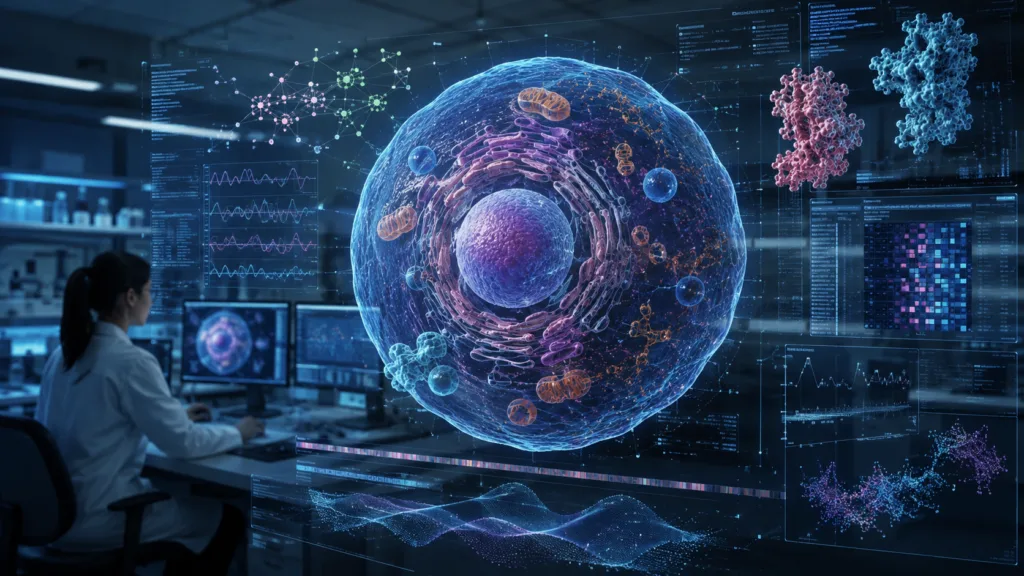
That distinction is important. Many artificial intelligence systems in biology are exceptionally capable within individual tasks, yet living cells do not operate as collections of independent prediction problems. DNA regulation affects RNA expression, proteins interact with one another, molecular changes alter cell structure and behaviour, and those effects can evolve after an intervention. GenBio AI is attempting to make those relationships part of a common simulation framework rather than forcing researchers to interrogate each layer separately. The company describes AIDO as connecting biological information from molecules through phenotypes and supporting prediction, generation and simulation.
The more consequential question is therefore not whether GenBio AI can produce another strong biological benchmark. It is whether a multimodal model can become sufficiently reliable outside familiar training distributions to help scientists decide which hypotheses, drug candidates or genetic perturbations deserve expensive experimental follow-up.
What makes GenBio AI’s virtual cell a world model rather than another biological foundation model?
GenBio AI has set a relatively demanding definition for what it believes should qualify as a virtual cell world model. Its technical framework describes a system that maintains a representation of biological state, accepts interventions as actions and models how that state changes afterwards. The proposed architecture is intended to support action-conditioned simulation, counterfactual reasoning and longer sequences of biological interventions rather than producing only a single static answer.
In practical terms, that could eventually allow a researcher to specify the starting condition of a cell, introduce a perturbation such as a gene knockout or compound, examine the predicted resulting state and then apply another intervention. GenBio AI has said its approach is designed to span molecular, structural, interactional and morphological outputs within an aligned multimodal system.
That is materially different from asking an algorithm only what genes may become more or less active after an intervention. A genuine simulation environment would need to preserve enough information about the cell’s evolving state for effects to propagate between biological layers and over time.
GenBio AI has described its architecture around a generative latent prediction framework. The conceptual advance is to model the underlying state of a biological system and its transition after an action, rather than requiring every component to be reconstructed independently from raw observations. Eric Xing and colleagues have argued that multimodality, stateful representations, action conditioning and dynamic rollouts are among the features needed before a biological model should reasonably be described as a world model.
Why could connecting genomics, proteins and morphology matter for drug discovery?
Drug discovery is fundamentally a perturbation problem. A compound is introduced because researchers hope it will alter a biological system in a desirable way without creating unacceptable effects elsewhere.
Yet the measurable consequences of that perturbation occur at several levels. Transcription may change. Protein abundance or interaction may change. Signalling networks may reorganise. Cell shape, localisation or function may change. Looking at one of these layers alone can provide useful information while still missing the wider biological response.
GenBio AI has previously described its virtual cell programme as covering genomic, transcriptomic, protein and morphological simulation and prediction. Its broader AIDO strategy is intended to link biological information from molecular events to observable phenotype.
If that integration eventually proves reliable, one of the most valuable applications may not be replacing experiments but ranking them.
A pharmaceutical research team might computationally test thousands of candidate perturbations, identify a smaller set with interesting predicted responses and then concentrate wet lab resources on those experiments. The potential efficiency comes from changing the order of operations. Computational screening would narrow the search space before expensive biological testing, while experiments would remain necessary to establish whether the model’s predictions correspond to actual biology.
That qualification is crucial. A virtual cell prediction is not evidence that a drug works, that a molecular mechanism is correct or that an intervention will be safe in animals or humans. Even a highly accurate cellular model would represent only part of a drug development pathway that ultimately includes tissue biology, pharmacokinetics, toxicity, immune effects, whole-organism physiology and clinical variability.
How much experimental evidence supports GenBio AI’s virtual cell approach so far?
GenBio AI has already reported encouraging results from components intended to support its larger virtual cell programme, although those results should not be confused with comprehensive validation of the newly announced world model.
Its VCHarness system, for example, autonomously designs and evaluates models for predicting cellular responses to CRISPR gene knockdown. GenBio AI reported testing the system across K-562, HepG2, Jurkat and hTERT-RPE1 human cell lines and said VCHarness produced models that ranked at or near the top against expert-designed approaches.
The company reported substantial improvements during individual model-search campaigns. For HepG2 cells, validation F1 increased from 0.157 to 0.531, while hTERT-RPE1 improved from 0.3445 to 0.5182. Jurkat rose from 0.4041 to 0.4843 and K-562 from 0.4585 to 0.5128 during the disclosed searches. GenBio AI said the system combined different biological foundation models, graph information and model architectures as it learned which configurations performed better.
Those experiments demonstrate something useful about autonomous model construction and perturbation-response prediction. They do not, however, establish that a complete multimodal virtual cell can accurately simulate arbitrary drugs, genetic alterations or diseases across unfamiliar biological contexts.
That broader validation challenge is substantial. The emerging virtual-cell field itself has highlighted data heterogeneity, biological noise, reproducibility, benchmark fragmentation and the need for evaluations that test genuine biological generalisation rather than performance within familiar datasets.
The strongest future evidence would therefore come from prospective experiments in which the model predicts an undisclosed cellular response before investigators perform the corresponding wet lab experiment.
Is GenBio AI really the first company building a world model for biology?
The word “first” needs careful handling because world model terminology is developing quickly and different organisations define the concept differently.
GenBio AI describes its system specifically as a virtual cell world model built around dynamic biological states, action conditioning and multiscale simulation. However, it is not the only company using world-model language in computational biology.
Bioptimus, for example, introduced M-Optimus-1 in May 2026 as an early iteration of its own world model for biology. M-Optimus combines pathology and molecular information and is intended to integrate biological modalities across scales. Bioptimus has separately described M-Optimus-1 as the first world model of biology.
Other research groups are also moving toward generative cellular models. Recent work includes models focused on transcriptomic state, perturbation responses and latent representations of cells, illustrating that “virtual cell” now describes an increasingly broad research frontier rather than a single standardised architecture.
GenBio AI’s differentiation is therefore better understood through the architecture it is pursuing rather than through an uncontested historical claim. The company is arguing that a virtual cell should behave more like a simulator, maintaining state and allowing successive interventions across multiple biological modalities, rather than functioning as a specialised predictor.
If that architecture works as intended, the distinction could become meaningful. For now, the field does not have a universally accepted test that can certify one platform as the definitive first world model of a human cell.
How does the NVIDIA collaboration fit into GenBio AI’s attempt to scale virtual cells?
Scale is likely to become one of the practical constraints separating interesting virtual-cell prototypes from platforms that pharmaceutical researchers can use routinely.
GenBio AI announced a collaboration with NVIDIA in June to accelerate development of virtual-cell world models. The company said it is integrating NVIDIA BioNeMo, NVIDIA Megatron, NVIDIA NIM microservices and the NVIDIA BioNeMo Agent Toolkit into parts of its development stack.
The relationship is particularly relevant to VCHarness. That system repeatedly proposes model designs, writes and debugs code, launches experiments, evaluates outputs and uses the results to choose subsequent experiments. Such autonomous searches can generate considerable computational workloads because the system may evaluate many alternative architectures before identifying strong candidates.
This infrastructure layer could become commercially important if virtual-cell platforms move from research demonstrations toward high-throughput screening. Simulating a handful of perturbations is one problem. Running enormous combinations of compounds, genetic backgrounds, doses and cellular conditions while maintaining multiple biological representations would create a much larger compute requirement.
GenBio AI will therefore need to demonstrate not only biological accuracy but also whether the economics of these simulations are attractive relative to the experiments they are designed to prioritise or avoid.
What must GenBio AI prove before virtual cells can influence routine pharmaceutical research?
The next stage is likely to be less about increasingly dramatic descriptions of virtual biology and more about experimental validation.
Researchers will need evidence that predictions remain reliable when the model encounters cell types, genetic backgrounds, drugs, environmental conditions and combinations materially different from its training data. Models that perform strongly on established benchmarks but deteriorate under distribution shift would have limited value for discovering genuinely new biology.
Multimodal consistency will also matter. If a predicted transcriptional response suggests one cellular state while predicted protein behaviour or morphology points toward another, the system needs a principled way to reconcile those outputs. Biological world models will ultimately be judged not merely by individual benchmark scores but by whether their simulated internal biology remains coherent.
Prospective wet lab confirmation may become the most commercially meaningful measure. A model that repeatedly makes useful predictions before experiments are run could help pharmaceutical companies prioritise targets, compounds and mechanistic hypotheses. A model that mainly reconstructs patterns already represented in historical datasets would still be scientifically useful, but its ability to reduce drug discovery risk would be much more limited.
GenBio AI has nevertheless crossed an interesting threshold. Its original AIDO programme began as interconnected foundation models for DNA, RNA, proteins and cells. The new world-model direction attempts to make those components behave more like one evolving biological system. GenBio AI’s earlier AIDO.Cell models, for instance, were pretrained on about 50 million human cells and were designed for tasks including cell classification and perturbation modelling, establishing one of the building blocks from which the broader simulation strategy has developed.
The ambition is considerable, but the commercial test is straightforward: can simulated biology make wet lab decision-making measurably better?
If GenBio AI can show that its virtual cell predicts previously unseen experimental responses accurately enough to change which drug hypotheses researchers pursue, the platform could become far more than an impressive collection of biological AI models. Until those prospective validations accumulate, the human cell world model is best viewed as a significant engineering step toward computational biology that behaves increasingly like simulation, rather than a digital substitute for the living cell.