Antibody-drug conjugates are often described with an appealingly simple analogy: an antibody finds the cancer cell and delivers chemotherapy directly to it. The reality is considerably more complicated. An ADC is simultaneously a biologic, a chemical delivery system and an extremely potent small-molecule drug, and changing any one of those components can alter where the treatment travels, how long it remains stable in circulation, how efficiently it enters cancer cells, whether it kills neighboring cells and which toxicities eventually limit the dose. The field has expanded to more than 20 approved ADCs globally and hundreds of clinical-stage candidates, but the growing number of programmes has made one principle increasingly clear: knowing the target antigen is no longer enough to predict how an ADC will perform.
That is why two ADCs aimed at HER2, TROP2 or another identical surface protein can produce meaningfully different efficacy and safety profiles. The antibody may provide the molecular address, but the linker, payload, conjugation chemistry, drug-to-antibody ratio and ability of released drug to move between cells can determine how much useful cytotoxic activity actually reaches a heterogeneous tumor. Modern ADC development is consequently becoming less a search for the next antigen and more an exercise in engineering the complete delivery system around the biological problem a particular cancer presents.
Why does targeting the same antigen not make two ADCs equivalent?
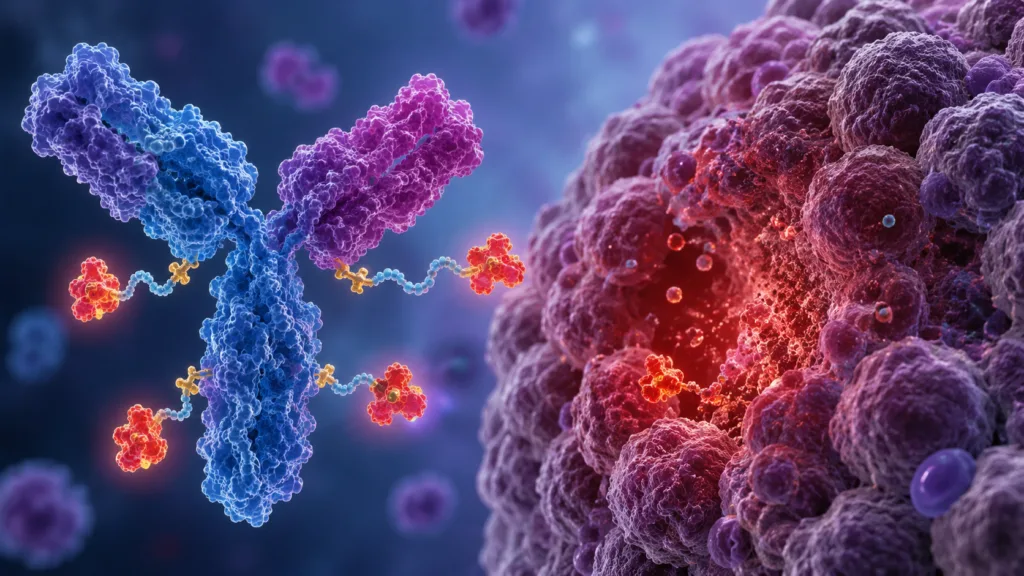
Every conventional ADC contains three principal components: an antibody recognizing a tumor-associated antigen, a cytotoxic payload and a chemical linker connecting the two. The drug-to-antibody ratio, or DAR, describes approximately how many payload molecules are attached to each antibody and provides another major design variable. Increasing DAR can theoretically deliver more cytotoxic molecules with every successful binding event, but excessive drug loading can alter solubility, pharmacokinetics, stability and clearance, meaning more payload does not automatically translate into a better medicine.
The antibody itself also does more than recognize a name on a pathology report. Binding affinity, epitope location and how rapidly the antigen-antibody complex is internalized can affect how deeply the ADC penetrates a tumor and where its payload is ultimately released. Very strong binding close to blood vessels can sometimes produce a so-called binding-site barrier, in which molecules are captured by antigen-rich cells near the vasculature and penetrate less effectively into deeper tumor regions. Solid tumors add abnormal blood vessels, high interstitial pressure, hypoxia and uneven antigen distribution, creating physical obstacles that an ADC has to overcome before its payload can kill enough malignant cells.
These variables help explain why drug developers increasingly characterize ADCs according to complete architectures rather than target alone. A HER2-directed ADC carrying a membrane-permeable topoisomerase I inhibitor through a cleavable linker can behave fundamentally differently from another HER2 ADC whose non-cleavable linker releases a less diffusible payload only after intracellular degradation. The antigen is identical, but the radius of cell killing, exposure of healthy tissues and resistance mechanisms can be very different.
Why has linker chemistry become one of the most valuable parts of an ADC?
The linker has to solve two competing problems. It should remain stable enough in circulation that the ADC does not spill highly potent chemotherapy into healthy tissue, yet it must release the payload efficiently after the antibody reaches the tumor. Premature cleavage can increase systemic toxicity and reduce the amount of active drug reaching malignant cells, while a linker that is too stable can prevent adequate payload release and weaken efficacy.
Cleavable linkers are designed to respond to conditions such as protease activity, acidity or other characteristics encountered after tumor-cell uptake or within the tumor microenvironment. Non-cleavable linkers generally require more complete intracellular degradation of the antibody before an active payload-containing metabolite is released. Neither architecture is universally superior because the correct choice depends on target expression, desired bystander activity, payload chemistry and acceptable toxicity.
This has turned linker engineering into an innovation field in its own right. Researchers are examining new cleavage mechanisms and computational approaches for identifying chemical structures capable of balancing plasma stability with controlled tumor release. Some experimental designs even attempt to amplify payload release through biological processes occurring after initial cancer-cell death, potentially extending the killing effect through heterogeneous tumor tissue. Those approaches remain largely developmental, but they illustrate how far ADC engineering has moved from the early assumption that a linker was merely an inert piece connecting antibody and chemotherapy.
What is the ADC bystander effect and why can it be both useful and dangerous?
A released payload does not necessarily remain inside the cancer cell that originally internalized the ADC. Some payloads can cross cell membranes and diffuse into neighboring cells, killing malignant cells even when they express little or none of the targeted antigen. This bystander effect can be extremely valuable in solid tumors because antigen expression is rarely uniform across every malignant cell. An ADC requiring high antigen expression and internalization in every target cell may leave antigen-low populations alive, whereas a membrane-permeable payload can extend the therapeutic effect beyond the directly targeted cells.
The same property creates risk because payload molecules do not know whether the neighboring cell they enter is malignant. Greater diffusibility can widen antitumor coverage while also increasing exposure of healthy tissue, meaning developers have to balance heterogeneity against off-target toxicity. Cleavable linkers, membrane permeability and payload hydrophobicity all influence this balance.
Trastuzumab deruxtecan has become an important clinical illustration of why architecture matters. Although it and trastuzumab emtansine both target HER2, they differ substantially in linker-payload design, DAR and bystander capability, contributing to markedly different clinical behavior. The broader lesson is that target expression should increasingly be thought of as a spectrum rather than a binary positive-or-negative characteristic, particularly as ADCs expand into tumors with lower or spatially heterogeneous antigen levels.
How do cancers become resistant to ADCs?
Cancer can interfere with virtually every stage of ADC action. A tumor may decrease or heterogeneously express the target antigen, alter internalization and lysosomal trafficking, increase drug-efflux pumps capable of removing the released payload, become resistant to the payload’s intracellular target or modify survival pathways that allow malignant cells to tolerate the resulting DNA or microtubule damage. Several resistance mechanisms can occur simultaneously, making an ADC considerably more complex than a conventional targeted antibody whose principal vulnerability might be loss or mutation of one signaling pathway.
Resistance can also arise without complete antigen loss. An ADC may continue binding cancer cells but fail because the antibody is processed differently, because lysosomal function changes or because the payload itself encounters classical chemotherapy resistance mechanisms. This is one reason switching from one ADC to another directed at the same antigen can sometimes remain biologically plausible: if the second product uses a different payload or linker, it may evade a resistance mechanism affecting the first. Whether that works clinically depends on the specific disease and resistance biology rather than target identity alone.
Liquid biopsy and single-cell technologies are increasingly being explored to characterize how tumors evolve during ADC therapy. Instead of testing antigen expression once before treatment and assuming it remains unchanged, future treatment selection may require longitudinal assessment of target density, resistant clones and payload-resistance pathways. That would push ADC medicine closer to the adaptive precision-oncology model already developing around targeted small molecules.
Why is ADC toxicity not simply ordinary chemotherapy toxicity?
The promise of an ADC is selective delivery, not complete elimination of systemic exposure. ADCs circulate through normal organs, some target antigens are expressed at lower levels in healthy tissue, payload can occasionally be released prematurely and the intact conjugate or its metabolites can distribute in ways that generate characteristic organ toxicities. Different ADC architectures therefore produce different safety profiles even when they share a target.
Pulmonary, hematologic, ocular, hepatic, gastrointestinal, neurological and dermatologic toxicities have all become important across different ADC families. When ADCs are combined with immune checkpoint inhibitors, clinical interpretation becomes even more complicated because both treatments can injure overlapping organs, making it difficult to determine which drug caused pneumonitis, hepatitis or other adverse events and whether either treatment can safely be restarted.
This is why the therapeutic index remains the central engineering challenge. The most successful ADC is not necessarily the one carrying the most powerful payload or generating the strongest bystander effect; it is the one that exposes the tumor to enough active drug while keeping clinically significant normal-tissue exposure within manageable limits.
What will define the next generation of antibody-drug conjugates?
The field is already moving beyond the historical menu of microtubule poisons and topoisomerase I inhibitors. Developers are exploring new cytotoxic mechanisms, immune-modulating payloads, radiopharmaceutical payloads and other drug classes capable of changing what happens after the antibody reaches its target. Antibody engineering, site-specific conjugation, dual-payload strategies and improved linker design are also being investigated to address resistance and widen therapeutic windows.
The competitive advantage may increasingly come from matching architecture to tumor biology. Highly heterogeneous tumors may benefit from carefully controlled bystander activity, whereas homogeneously expressed targets might support less diffusible payloads with lower off-target exposure. Tumors resistant to topoisomerase I inhibition may require a different payload class rather than merely another antibody against a new antigen.
That makes the future of ADC development much less intuitive than the phrase “targeted chemotherapy” suggests. The antibody still determines where the medicine tries to go, but the linker determines when the drug is released, the payload determines what damage occurs, the DAR changes how much drug travels with each antibody and the surrounding tumor determines how far the effect spreads. The next major ADC breakthroughs may therefore come not from discovering another cancer marker, but from designing better combinations of components around targets medicine already knows.