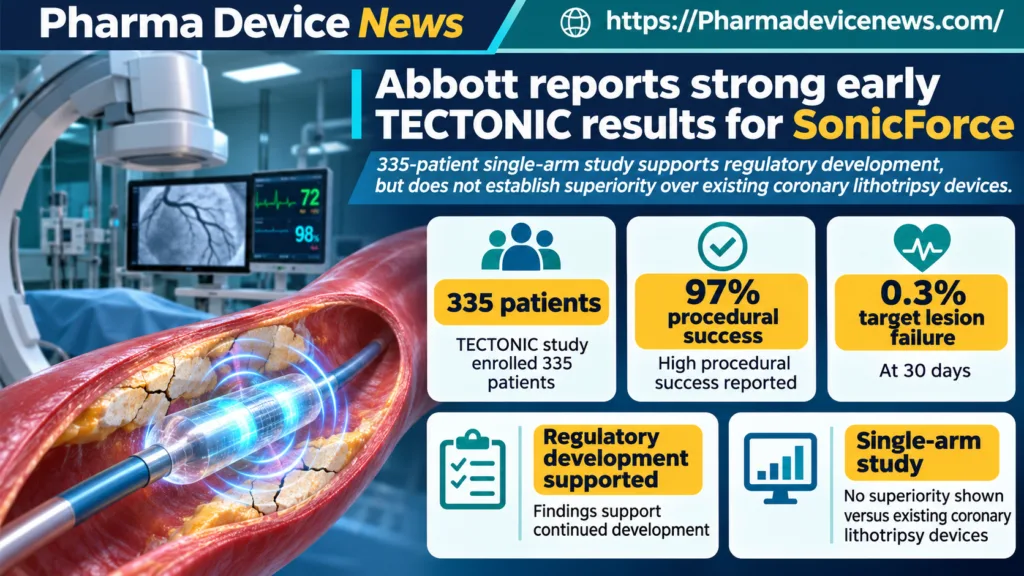
Abbott Laboratories (NYSE: ABT) has reported positive 30-day clinical results from its pivotal TECTONIC study of the investigational SonicForce Coronary Intravascular Lithotripsy System, demonstrating 97% procedural success and a target lesion failure rate of just 0.3% among patients with severely calcified coronary artery disease. Announced on November 1, 2026, the findings come from a 335-patient investigation conducted at 40 centres across the United States and represent an important step towards potential regulatory approval of Abbott’s newest coronary calcium modification technology.
The study met both its primary safety and effectiveness endpoints, while a prespecified optical coherence tomography substudy involving 106 patients provided imaging evidence of calcium fractures and improved stent expansion following treatment. SonicForce uses acoustic pressure waves delivered through a balloon-based catheter to modify hard calcium within coronary arteries before stent implantation. The technology is designed to improve vessel preparation in anatomically challenging lesions where inadequate stent expansion can compromise procedural outcomes.
However, the strong early findings should not be interpreted as evidence that SonicForce is superior to existing coronary intravascular lithotripsy systems. TECTONIC was a single-arm investigation without a randomised active-device comparator, and the principal clinical follow-up currently covers approximately 30 days. SonicForce also remains investigational and has not received marketing approval from the United States Food and Drug Administration.
What did Abbott’s 335-patient TECTONIC coronary lithotripsy study establish about safety and procedural success?
The TECTONIC Coronary Artery Disease Intravascular Lithotripsy Investigational Device Exemption study evaluated SonicForce in patients undergoing percutaneous coronary intervention for severely calcified coronary lesions. The investigation enrolled 335 patients at 40 American clinical centres, providing experience across different operators and hospital settings. Its primary objectives were to assess whether the technology could prepare calcified vessels successfully for stent implantation while maintaining an acceptable short-term safety profile.
The primary effectiveness endpoint was procedural success, defined by successful stent delivery with final residual narrowing below 50%, as assessed by an independent core laboratory, and the absence of in-hospital target lesion failure. Abbott reported that 97% of patients achieved this outcome. This demonstrates a high rate of successful completion under the study’s prespecified definition, although it does not mean every participant achieved an optimal final stent diameter or remained free from complications indefinitely.
The primary safety endpoint was target lesion failure at 30 days. The reported rate was 0.3%, indicating that events included in the composite were uncommon during the initial follow-up period. The study’s definition incorporated cardiac death, target-vessel myocardial infarction and clinically driven repeat treatment of the target lesion.
Major adverse cardiovascular events were also reported in 0.3% of the as-treated population. Abbott defined this secondary composite as cardiac death, all myocardial infarction and target-vessel revascularisation. Because the composite definitions differ, the two percentages should not be treated as identical measurements even though their reported values were the same.
These results strengthen the evidence supporting the device’s short-term procedural performance. Nevertheless, a low event rate in an uncontrolled study does not establish a reduction in complications relative to established treatment methods.
Why is severe coronary artery calcification such a major challenge during stent implantation?
Coronary artery disease develops when atherosclerotic plaque accumulates within the arteries supplying blood to the heart. Over time, some plaques become heavily calcified, creating rigid segments that are difficult to expand using conventional balloon angioplasty. Severe calcification can prevent a stent from reaching the intended diameter or achieving uniform contact with the vessel wall.
Inadequate stent expansion matters because the implanted device must maintain a sufficiently open artery to support blood flow. Underexpanded stents may be associated with future complications, including recurrent narrowing and stent thrombosis. The relationship between calcification and procedural outcomes makes vessel preparation a central part of treating complex coronary lesions.
Physicians have several approaches for modifying calcium, including specialised high-pressure balloons, cutting or scoring balloons and atherectomy devices. The choice depends on lesion morphology, whether a catheter can cross the narrowing and the operator’s assessment of risk. Some approaches mechanically remove or modify plaque, while others attempt to alter its structure so the artery can expand more effectively.
Intravascular lithotripsy uses acoustic energy to fracture calcified tissue. By modifying the rigidity of the lesion, it aims to facilitate subsequent balloon expansion and stent implantation. However, the effectiveness of the approach depends on reaching the lesion, delivering sufficient energy and achieving appropriate vessel preparation without introducing unacceptable injury.
SonicForce enters this treatment landscape as an additional investigational technology. Its importance lies in whether Abbott can provide physicians with a reliable alternative for difficult calcium patterns, particularly when conventional preparation approaches are insufficient.
How does Abbott’s SonicForce system use acoustic pressure waves to modify coronary calcium?
SonicForce is a balloon-based intravascular lithotripsy system designed to deliver acoustic pressure waves to calcified coronary lesions. The principle resembles the use of shock waves in treatments for kidney stones, although coronary applications involve different equipment, anatomy and treatment objectives. Instead of attempting to remove the entire calcium deposit, the system seeks to create fractures that make the vessel easier to expand.
The investigational catheter is designed to deliver up to 160 lithotripsy pulses at a rate of two pulses per second. Abbott has emphasised longer treatment lengths, additional pulse capacity and improved catheter deliverability as important design features. These characteristics are intended to help operators manage calcified segments requiring extensive lesion preparation.
A greater number of available pulses may provide additional flexibility during a procedure, particularly when operators need to modify a longer or more resistant lesion. However, pulse capacity alone does not establish greater effectiveness. The clinical result depends on how the energy interacts with calcium, the balloon’s position and the characteristics of the treated artery.
Catheter deliverability is another important consideration because severely calcified lesions can be difficult for devices to cross. A system that cannot reach the treatment site cannot provide its intended mechanical benefit. The announcement identifies enhanced deliverability as a design goal, but it does not provide a direct comparative measurement against competing devices.
Abbott will need to demonstrate how these technical characteristics affect procedure duration, lesion preparation and outcomes under routine clinical conditions. The TECTONIC findings provide an initial foundation, but comparative evidence would be required to establish a distinctive performance advantage.
What did optical coherence tomography reveal about calcium fractures and stent expansion?
The TECTONIC programme included a prespecified imaging substudy involving 106 patients. Investigators used optical coherence tomography, an intracoronary imaging technique that provides detailed views of vessel structures, to evaluate the effects of SonicForce treatment. The analysis identified calcium fractures following lithotripsy and demonstrated improvement in subsequent stent expansion.
This imaging evidence is important because it provides direct support for the device’s intended mechanism. Procedural success can demonstrate that a stent was delivered and the artery expanded, but imaging can help explain how the underlying calcium was modified. Observing fractures provides a mechanistic link between acoustic treatment and changes in vessel compliance.
The American College of Cardiology also reported that optical coherence tomography and intravascular ultrasound findings supported calcium modification and lumen expansion. These observations strengthen confidence that SonicForce produces the physical effects it was designed to achieve. However, the imaging substudy represents a selected subset of the overall trial population.
It is also important to distinguish calcium modification from prevention of future cardiovascular events. Successful fracture of a calcified lesion may contribute to improved immediate expansion, but it does not guarantee freedom from restenosis, myocardial infarction or repeat intervention over several years. Those outcomes require longer clinical observation.
The publicly released summary does not provide a complete distribution of calcium fracture measurements or detailed comparison of expansion by lesion type. Additional information from the full scientific publication will be important for determining which anatomical characteristics are associated with the strongest response.
Why should the 97% procedural success rate not be confused with proven superiority over existing devices?
A procedural success rate of 97% is encouraging, but its interpretation depends on the study design and the definition used. TECTONIC evaluated patients receiving SonicForce without randomly assigning another group to an established coronary lithotripsy system or alternative calcium modification strategy. Consequently, the trial does not directly measure whether SonicForce performs better than another treatment.
Single-arm device studies can be appropriate for evaluating safety and effectiveness against prespecified criteria or performance goals. They can establish whether a technology performs consistently in the intended population. However, they cannot eliminate differences arising from patient selection, operator experience or the characteristics of competing technologies.
The reported success definition involved stent delivery, residual stenosis and the absence of in-hospital target lesion failure. These are clinically relevant measures, but they are not equivalent to perfect stent expansion or sustained freedom from cardiovascular events. The 30-day safety findings also cannot establish durability over several years.
Comparisons with published results from other trials require particular caution. Studies may differ in lesion complexity, imaging requirements, vessel diameter and patient characteristics. Even identical percentages can have different meanings when endpoint definitions and patient populations are not comparable.
For Abbott, the most defensible conclusion is that SonicForce met the prespecified objectives of its pivotal investigation. Whether it offers superior deliverability, greater treatment flexibility or better long-term outcomes remains a separate question for further evaluation.
How could SonicForce compete with Shockwave Medical in the coronary intravascular lithotripsy market?
The coronary intravascular lithotripsy market already includes established technology from Shockwave Medical, which Johnson & Johnson acquired in 2024. Shockwave’s platform helped establish acoustic calcium modification as a treatment option for complex coronary intervention. Its commercial presence creates a meaningful competitive benchmark for Abbott’s investigational device.
SonicForce could become relevant to hospitals seeking additional choices within coronary calcium modification. Potential differentiators include catheter design, pulse capacity, treatment length and compatibility with procedural workflows. However, these characteristics must translate into measurable benefits before they can support a claim of superior performance.
Johnson & Johnson’s existing presence also means Abbott would be entering a market with established physician training, procurement relationships and clinical familiarity. New medical devices must compete not only on technical specifications but also on reliability, support, cost and integration with existing clinical practices.
Abbott may benefit from its extensive cardiovascular portfolio, including coronary imaging, guidewires, stents and other interventional technologies. Offering a complementary lithotripsy system could allow the company to provide a more integrated approach to lesion preparation and treatment. Nevertheless, ownership of related technologies does not guarantee adoption of SonicForce.
The competitive impact remains conditional on FDA authorisation and eventual commercial launch. Abbott has not disclosed SonicForce pricing, sales targets or a market introduction date, making its prospective revenue contribution impossible to quantify reliably.
What regulatory steps remain before Abbott can commercially launch SonicForce in the United States?
SonicForce is being evaluated under an FDA Investigational Device Exemption, which permits the authorised clinical investigation to proceed. The completion of the pivotal study’s primary endpoints represents a significant development milestone, but IDE status is distinct from permission to sell a device for routine clinical use. Abbott has explicitly confirmed that SonicForce has not received FDA marketing approval.
The company must complete the relevant regulatory process using clinical, technical and manufacturing evidence. The applicable submission will need to support the device’s intended use, safety and effectiveness. The regulator may evaluate information extending beyond the reported 30-day outcomes, including relevant device performance and risk-management documentation.
The precise submission timetable has not been disclosed. Although the positive pivotal findings strengthen the development case, they do not establish when a regulatory decision will occur. Additional information requests or other review considerations could influence the process.
Abbott will also need to prepare the commercial infrastructure required for physician training, device supply and technical support. Such preparations can begin before authorisation, but commercial sales remain subject to the applicable regulatory requirements. The company has not announced confirmed US orders or installations.
The immediate milestone is therefore the transition from successful clinical evaluation towards regulatory review. The full commercial significance will become clearer only after an authorisation decision and subsequent launch disclosures.
What do Abbott’s latest financial results and share performance suggest about investor sentiment?
Abbott reported third-quarter 2026 sales of approximately $13.01 billion, representing reported growth of 14.5% from the previous year. Comparable sales increased 7.0%, while adjusted diluted earnings per share reached $1.42. The company maintained the midpoint of its full-year adjusted earnings outlook and narrowed the guidance range to $5.50–$5.55 per share.
These results provide context for SonicForce’s development within a diversified healthcare business spanning medical devices, diagnostics, nutrition and established pharmaceuticals. Abbott has sufficient commercial breadth that a single investigational catheter system is unlikely to determine its near-term financial performance. Nevertheless, successful cardiovascular launches can contribute to longer-term portfolio growth.
Abbott shares closed at $106.20 on October 30, 2026, increasing 1.56% during the session. The stock remained below its 52-week high of $132.03 and above its 52-week low of $81.97. The SonicForce results were announced on November 1, after the preceding regular US trading session, so the October 30 price increase cannot be attributed to the clinical announcement.
The positive trial findings may strengthen perceptions of Abbott’s coronary device pipeline, but their financial significance remains uncertain. The company has not disclosed forecast revenue, expected margins or commercial pricing for SonicForce. Investors will need to distinguish a successful regulatory development milestone from an immediately measurable earnings catalyst.
The longer-term opportunity involves adding another tool to Abbott’s established interventional cardiology business. Its value will depend on regulatory authorisation, physician adoption and the extent to which the product can compete effectively within the existing lithotripsy market.
What must Abbott demonstrate before SonicForce becomes an established coronary calcium treatment?
The first requirement is completion of the applicable regulatory review. TECTONIC has produced favourable primary endpoint results, but the device remains investigational. FDA authorisation will determine whether Abbott can introduce it commercially under the proposed indication.
The second requirement is evidence of consistent performance across routine clinical environments. Severely calcified coronary lesions differ in length, distribution and anatomical complexity. Physicians will need to understand which lesion characteristics are best suited to SonicForce and whether its technical features provide practical advantages.
Longer-term safety and effectiveness will also matter. Low 30-day target lesion failure is reassuring, but stent-related outcomes can emerge after the initial follow-up period. Further observation and real-world evidence could help assess the durability of procedures performed using the device.
Commercial adoption will depend on the complete value proposition. Hospitals must consider the cost of equipment and consumables, training requirements, procedure efficiency and the availability of competing technologies. A high procedural success rate provides an important foundation but does not independently establish economic superiority.
Abbott has reported one of the most important recent clinical milestones in its coronary device pipeline, with SonicForce achieving 97% procedural success and a 0.3% target lesion failure rate. The findings demonstrate encouraging short-term performance and imaging evidence supporting the intended mechanism. The decisive next steps will be regulatory authorisation and evidence showing whether the system provides meaningful clinical and operational differentiation in everyday coronary intervention.