MD Hyperbaric is expanding its medical-grade hyperbaric oxygen therapy network with new centers planned in San Antonio, Las Vegas and Rochester, alongside its recently opened Boulder location. The expansion places the U.S.-based hyperbaric oxygen therapy provider deeper into a fast-widening recovery, wound healing and wellness market where clinical credibility, safety standards and patient access are becoming central competitive issues.
Why MD Hyperbaric’s national expansion matters for the medical-grade HBOT market
The significance of MD Hyperbaric’s expansion is not simply that another wellness-adjacent clinic operator is adding locations. The more important signal is that hyperbaric oxygen therapy is moving further into a hybrid commercial zone between traditional hospital-based use, sports recovery, post-surgical care and broader longevity-oriented consumer demand. That creates an opportunity for providers that can present HBOT as medically supervised care rather than a loosely defined wellness service.
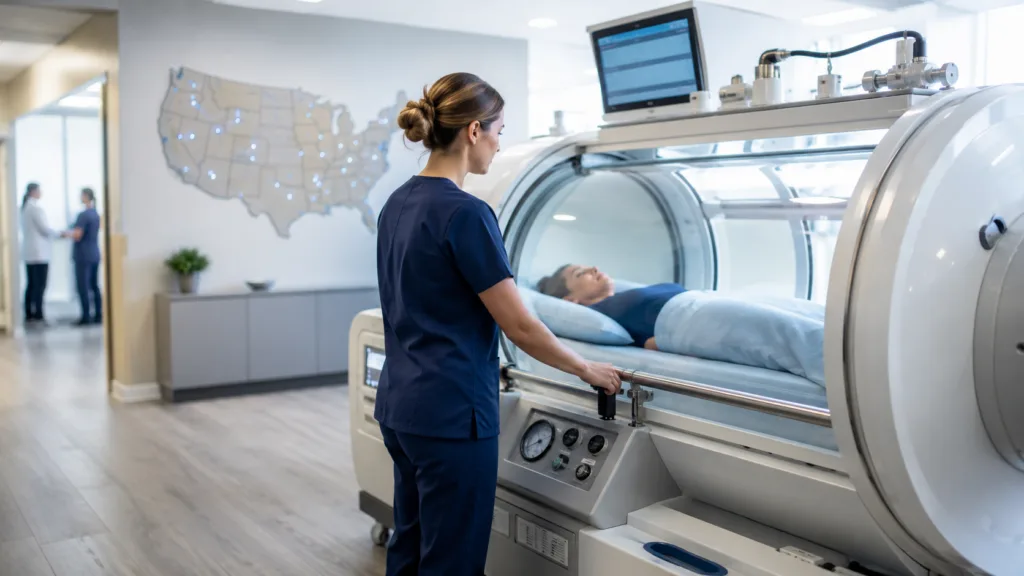
Hyperbaric oxygen therapy has long had established medical uses, particularly in areas such as wound care, radiation-related tissue injury and certain acute indications. What is changing is the commercial packaging around the modality. Independent clinic networks are attempting to make HBOT more accessible, more branded and more consumer-friendly while still leaning on medical-grade chambers, physician-directed protocols and clinical oversight. MD Hyperbaric’s entry into Texas, Nevada and New York reflects that shift toward a more distributed outpatient model.
The risk is that the market can easily blur the line between evidence-backed use and aggressive wellness positioning. HBOT carries strong recognition in some clinical settings, but its use for performance optimization, chronic inflammation, neurological recovery, Long COVID, Lyme disease and longevity support remains a more complex territory. For MD Hyperbaric, scaling nationally will require more than premium patient experience. It will require consistency in patient screening, treatment protocols, documentation, outcome tracking and claims discipline across locations.
How medical-grade HBOT clinics are trying to move beyond hospital wound care settings
Hospital-based hyperbaric programs have historically served patients with more narrowly defined medical needs, often within wound care, radiation injury or specialist referral pathways. The clinic model being advanced by providers such as MD Hyperbaric is different. It brings HBOT into outpatient, consumer-facing settings where patients may seek therapy for recovery, inflammation, post-surgical healing, sports injury support and broader wellness goals.
That model could expand access for patients who may not fit neatly into hospital-based pathways but still want medically supervised HBOT. It also allows providers to build a recurring care relationship around multi-session treatment plans, which is commercially attractive in a healthcare market increasingly shaped by elective, cash-pay and hybrid reimbursement services. The premium clinic format can make the treatment experience less intimidating than hospital-based care, especially for patients seeking recovery rather than acute intervention.
However, the model also faces the burden of differentiation. A medical-grade positioning only works if patients, clinicians and referral partners can clearly see what separates a provider from lower-rigor operators. FDA-cleared chambers, physician-designed protocols and clinical teams are useful markers, but they are not enough on their own. The real test is whether a national network can maintain standardized protocols while adapting to different patient populations, local referral networks and state-level healthcare operating requirements.
What the expansion reveals about demand for recovery, healing and longevity services
The broader context behind MD Hyperbaric’s expansion is the rising consumer and clinician interest in services that sit between conventional medical treatment and proactive recovery support. Patients recovering from surgery, athletes managing injuries and individuals seeking long-term wellness interventions are increasingly looking for therapies that appear measurable, technology-enabled and clinically guided. HBOT fits into that demand profile because it has a recognizable mechanism, a structured treatment environment and a clear experiential format.
For clinic operators, this makes HBOT attractive because it is not simply a one-off retail wellness service. Sessions can be repeated, protocols can be personalized and the treatment setting can be standardized across locations. That creates a platform-like business model, where site expansion, referral development and patient retention become the key levers. MD Hyperbaric’s move into San Antonio, Las Vegas and Rochester suggests confidence that demand is not confined to coastal wellness hubs or elite sports markets.
The unresolved question is how much of this demand will convert into sustained, clinically credible utilization. Wellness markets can expand quickly when consumer interest rises, but they can also become crowded and uneven when claims outpace evidence. For HBOT providers, the challenge is to avoid being pulled too far into vague anti-aging or performance narratives without sufficient clinical guardrails. The opportunity is real, but the reputational risk is just as real if the category becomes overpromoted.
Why FDA-cleared chambers and physician-directed protocols could become key differentiators
MD Hyperbaric is leaning heavily on medical-grade chambers, provider-designed protocols and clinical rigor as its core differentiation. That positioning matters because HBOT is not a simple consumer device experience. Treatment involves pressure, oxygen delivery, patient selection and session duration, which means safety screening and supervision matter. In a fragmented market, clinical infrastructure can become the difference between a defensible healthcare service and a commoditized wellness offering.
For clinicians and referring providers, the value proposition will depend on whether MD Hyperbaric can show that its model is structured, repeatable and medically responsible. A patient seeking support after surgery, radiation therapy or injury may need more than access to a chamber. They may need coordinated care, documentation, monitoring and clarity about expected outcomes. A physician-directed model can help build that bridge, particularly if it supports communication with existing care teams.
The limitation is that the phrase “medical-grade” can become a marketing shorthand unless supported by transparent operational standards. Industry observers will likely watch whether MD Hyperbaric publishes more detail on treatment pathways, clinician oversight, contraindication screening, adverse event monitoring and outcome measurement. National growth raises the standard. Once a provider becomes multi-state, consistency becomes a clinical and brand challenge, not merely a real estate or staffing challenge.
How the new locations could reshape regional access to hyperbaric oxygen therapy
San Antonio, Las Vegas and Rochester are not identical markets, which makes the expansion strategically interesting. San Antonio brings a large healthcare base, a growing population and potential demand from post-surgical, sports medicine and veteran-adjacent communities. Las Vegas offers a mix of wellness demand, sports activity, tourism-driven healthcare services and a consumer base already familiar with elective recovery offerings. Rochester adds a different profile, with a more traditional medical and academic healthcare environment in upstate New York.
This geographic spread suggests MD Hyperbaric is not pursuing only one type of HBOT market. Instead, the U.S.-based provider appears to be testing or deepening a model that can work across large metros, wellness-oriented cities and more clinically anchored regional hubs. That could help the network avoid overreliance on one patient segment. It also provides room to develop referral channels across orthopedics, wound care, sports medicine, neurology, rehabilitation and post-operative recovery.
The execution risk is that each market will require different patient acquisition economics. A Las Vegas clinic may depend more heavily on consumer-facing recovery and wellness interest, while Rochester may require stronger clinical referral relationships. San Antonio may sit somewhere in between. National clinic expansion often looks clean on a map, but local traction depends on physician awareness, payer dynamics, staffing quality, patient education and whether treatment plans are priced in a way that supports repeat use.
What clinicians and regulators may watch as HBOT use expands into broader indications
Clinicians tracking HBOT are likely to focus on whether the therapy is being presented with enough nuance across different patient groups. Wound healing and post-radiation support carry a different level of clinical familiarity than performance optimization, chronic pain, neurological conditions or longevity support. A clinic network that serves all these categories must be careful not to flatten the evidence base into one broad recovery narrative.
Regulatory watchers may also pay attention to how providers describe the therapy in consumer-facing materials. HBOT itself is a recognized modality, but claims around specific conditions must be handled carefully. The more a provider expands into areas such as Long COVID, traumatic brain injury, chronic inflammation or longevity support, the more important it becomes to separate established indications from emerging, investigational or patient-reported use cases. That distinction matters for patient trust and for long-term category credibility.
The commercial risk is that cautious language can slow consumer conversion, while overly confident language can invite scrutiny. MD Hyperbaric’s challenge is to grow while staying disciplined. The strongest operators in this category are likely to be those that can educate patients without overselling, support clinicians without replacing their judgment and structure protocols without implying that HBOT is a universal solution.
Why reimbursement, affordability and repeat-session economics remain major barriers
Access is not only a question of location. For many patients, HBOT access will depend on whether a treatment pathway is reimbursed, partially covered or paid out of pocket. That matters because HBOT often involves multiple sessions, and repeated visits can quickly become expensive. Even with convenient clinic locations, affordability could shape how broad the addressable market really is.
For MD Hyperbaric, the premium patient experience may support a strong brand, but it may also narrow the reachable patient base if pricing is largely consumer-pay. Patients seeking wellness or athletic recovery may accept elective pricing more readily than patients dealing with complex recovery needs. Conversely, clinically referred patients may expect clearer reimbursement pathways or stronger medical justification before committing to multi-session plans.
This is where outcome data and protocol clarity become commercially important. A clinic network that can document patient experience, treatment adherence and measurable recovery signals may be better positioned to build referral confidence and payer discussions over time. Without that, expansion can still produce revenue growth, but it may remain more dependent on affluent consumers and self-directed patients than on broader medical adoption.
How MD Hyperbaric’s model could influence competition in the HBOT clinic sector
MD Hyperbaric’s expansion could intensify competition among hyperbaric oxygen therapy providers, sports recovery clinics, post-surgical recovery services and wellness centers trying to capture demand for non-pharmaceutical healing support. The competitive field is not limited to HBOT-only operators. It includes orthopedic recovery programs, regenerative medicine clinics, physical therapy groups, longevity clinics and premium wellness platforms that combine multiple modalities under one roof.
The advantage for a dedicated HBOT provider is focus. MD Hyperbaric can build its brand around clinical-grade oxygen therapy, staff training, chamber infrastructure and patient protocols. That focus may help establish trust in a market where general wellness centers sometimes add technologies without deep specialization. It can also support partnerships with physicians, surgeons and athletic communities that want a more controlled referral destination.
The disadvantage is that single-modality specialization can create pressure if patient demand becomes cyclical or if alternative recovery technologies compete for the same consumer budget. Competitors offering bundled recovery services may appeal to patients who want convenience and variety. MD Hyperbaric’s strongest path is therefore not simply to open more centers, but to show that a focused HBOT model can produce consistency, safety and patient satisfaction at scale.
What must go right for MD Hyperbaric’s national footprint to become defensible
The next phase for MD Hyperbaric will depend on operational discipline. New locations can extend the network, but the defensibility of the model will come from clinical consistency, referral development, staff training and patient outcome documentation. In healthcare services, brand expansion without protocol consistency can dilute credibility. That is especially true for a modality like HBOT, where patient expectations can range from medically necessary recovery support to aspirational wellness.
The most important strategic question is whether MD Hyperbaric can position itself as the clinical standard-setter in a market that could otherwise become crowded with looser operators. The U.S.-based provider has several useful ingredients, including physician-founded origins, medical-grade chambers, personalized protocols and a growing clinic footprint. The harder task is turning those ingredients into a repeatable national care model that clinicians trust and patients understand.
A neutral reading suggests that the expansion is strategically meaningful but not risk-free. It reflects growing demand for recovery-oriented services and wider interest in evidence-supported wellness infrastructure. However, the long-term opportunity will depend on whether MD Hyperbaric can maintain clinical guardrails while scaling across diverse regional markets. For the HBOT sector, that balance may decide whether the next growth wave looks like responsible outpatient access or another overheated wellness cycle.