Adaptyx Biosciences and Attune Neurosciences have launched a 24-month, $4 million study designed to investigate whether continuous molecular monitoring can identify an objective biological signature associated with chronic pain and changes in pain following treatment. The program is expected to enroll 100 adults with chronic pain, with an emphasis on U.S. military veterans, and will combine Adaptyx’s multi-analyte wearable biosensing technology with Attune’s investigational low-intensity focused ultrasound neuromodulation program.
The study sits within the Advanced Research Projects Agency for Health’s Evidence-Based Validation & Innovation for Rapid Therapeutics in Behavioral Health, or EVIDENT, initiative. There is an important funding distinction: Adaptyx and Attune describe the newly announced study as a $4 million project, while ARPA-H separately lists the wider Attune-led EVIDENT award at up to $8.4 million, with Keith Murphy as principal investigator. ARPA-H launched EVIDENT as an initiative worth up to $139.4 million across multiple research teams seeking more objective measures of response to behavioral-health interventions.
What makes the project particularly relevant to pain research is what it is not yet claiming. The study has not established an objective diagnostic test for chronic pain, nor has Adaptyx demonstrated that its five measured molecules can independently quantify an individual patient’s pain. Instead, investigators are attempting to discover whether combinations and trajectories of molecular, neurological and behavioral measurements correlate consistently enough with pain and treatment response to produce a scalable biomarker signature.
That distinction matters because the current regulatory framework remains centered on the patient’s experience of pain. In its May 2026 draft guidance on developing non-opioid analgesics for chronic pain, the U.S. Food and Drug Administration said primary endpoints in chronic-pain trials should generally use well-defined and reliable patient-reported measures of pain intensity, commonly an 11-point numerical rating scale. The agency nevertheless acknowledged that biomarkers and other innovative development approaches could potentially improve trial efficiency as scientific understanding advances.
What exactly is the ARPA-H chronic pain study trying to measure?
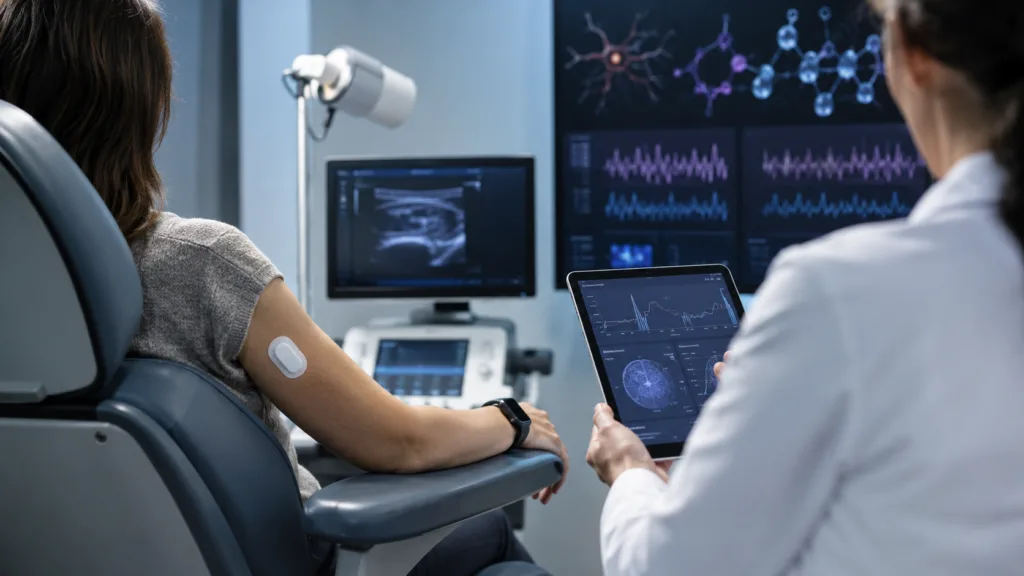
Participants in Attune Neurosciences’ Phase II chronic-pain research program are expected to wear Adaptyx sensors during and around focused ultrasound treatment sessions. According to the companies, the wearable will simultaneously monitor five molecular biomarkers, including cortisol and lactate, while wireless electroencephalography and smartwatches collect information about neural signals, activity and sleep. The objective is therefore not to find a solitary “pain molecule,” but to determine whether several biological and physiological signals form a reproducible pattern as pain varies.
ARPA-H describes the broader Attune project in similarly multimodal terms. Its award record says researchers will track brain activity, pain-related biological signals and remote-monitoring data, build models capable of predicting chronic-pain scores from the combined information, and identify measures suitable for larger-scale evaluation. The federal program also envisages assessing relationships with depression symptoms and sleep disturbance rather than reducing chronic pain to one isolated biological variable.
That strategy addresses one of the central problems in biomarker development for pain. Pain is an individual sensory and emotional experience influenced by underlying pathology, central nervous system processing, sleep, stress, mood, medication, physical activity and other variables. A cortisol increase, for example, cannot simply be interpreted as proof that someone is experiencing more pain, while lactate concentrations can change for reasons unrelated to chronic pain. A useful signature would therefore have to demonstrate specificity and reproducibility beyond correlations observed during a limited intervention period.
The study will also need to determine whether patterns discovered within individuals translate across participants. A molecular trajectory that follows symptom improvement in one patient could look different in another because of baseline physiology, medication exposure, pain subtype, comorbid conditions or individual differences in biomarker kinetics. That makes the 100-person program principally a discovery and validation exercise rather than evidence that an objective pain measurement system is ready for clinical use.
Why does continuous molecular sensing matter when pain still relies on patient-reported outcomes?
The potential advantage of continuous sensing is temporal resolution. Conventional laboratory tests provide measurements at individual moments, whereas a wearable can potentially show how a biological signal changes before, during and after treatment. For chronic-pain research, synchronizing those measurements with patient-reported pain, sleep, activity and neurological information could reveal relationships that would be invisible in isolated blood draws or periodic questionnaires.
Adaptyx is using programmable aptamer-based molecular switches, synthetic DNA structures engineered to produce measurable signals when they bind particular targets. Its broader technology traces to continuous molecular-monitoring work originating from H. Tom Soh’s Stanford University laboratory, where researchers have published extensively on aptamer switches, electrochemical sensing and continuous biochemical measurement.
Yet greater temporal resolution does not automatically produce a clinically meaningful biomarker. A wearable must reliably measure the relevant analyte at physiologically meaningful concentrations, remain stable during extended use, distinguish biological changes from sensor drift or movement artefacts, and demonstrate that measurements taken in dermal interstitial fluid correspond appropriately to the biological process being studied.
That last issue is especially significant. Stanford researchers reported in a 2026 Science Advances study in animals that molecular kinetics in blood and interstitial fluid can differ, including individualized temporal delays. The finding does not undermine interstitial-fluid monitoring, but it illustrates why interpreting a continuous wearable signal requires more than assuming that the value is an immediate substitute for a conventional blood measurement.
How strong is the evidence behind Adaptyx’s multi-analyte wearable platform?
Adaptyx has already moved part of its sensing platform into human research, but the evidence should be separated carefully from what the chronic-pain study is now attempting to establish. At the American Diabetes Association’s 86th Scientific Sessions in June 2026, the company reported first-in-human continuous multi-day measurements of free cortisol from dermal interstitial fluid. Its studies included an oral hydrocortisone challenge compared with paired venous measurements and overnight monitoring intended to capture natural cortisol rhythms.
Adaptyx said its broader institutional review board-approved human program had accumulated more than 400 hours of in-body monitoring and that it is pursuing a Class II regulatory pathway for a continuous cortisol monitor. Those statements represent company-reported development progress, not U.S. Food and Drug Administration clearance. The cortisol work also does not establish that five pain-related biomarkers can already be measured with equal analytical performance in humans or that their combined pattern is clinically informative for chronic pain.
This is where the ARPA-H project becomes a meaningful platform test for Adaptyx. The company says its research platform can handle as many as 16 markers simultaneously and that its initial commercial product is being developed for up to eight, with continuous hormone monitoring as its first commercial focus. The chronic-pain project gives Adaptyx an opportunity to show whether its programmable sensor architecture can move beyond a single extensively developed analyte such as cortisol and support clinically interpretable multiplex monitoring.
The company has publicly identified cortisol and lactate among the five molecules in the pain study, but it has not publicly named the entire panel in the announcement. That limits how far independent observers can evaluate the biological rationale, expected concentration ranges and specificity of each analyte before more study information becomes available. The commercially important milestone will therefore not be simply whether the wearable generates five continuous curves, but whether those curves remain analytically robust and collectively explain clinically relevant variation.
What does focused ultrasound add to the chronic pain biomarker-validation strategy?
Attune provides the intervention around which those biological changes will be examined. The company is developing wearable low-intensity focused ultrasound technology intended to stimulate deep brain targets non-invasively, with chronic pain among the conditions under investigation. ARPA-H identifies Attune as one of the EVIDENT performers contributing low-intensity focused ultrasound data for chronic pain and depression.
Pairing biomarker monitoring with an intervention is strategically useful because investigators need a detectable change against which biological measurements can be compared. If pain intensity and function change following neuromodulation, researchers can examine whether molecular, EEG, activity and sleep measurements change in parallel, precede the clinical response or separate apparent responders from non-responders.
That design does not, however, mean the biomarker project itself proves that focused ultrasound effectively treats chronic pain. Attune’s technology remains investigational, and evidence from other ultrasound neuromodulation experiments or healthy-volunteer studies cannot be substituted for controlled efficacy evidence in chronic-pain patients. The biological-signature question and the therapeutic-efficacy question are related but analytically distinct.
This separation will become important as data emerge. If participants report substantial pain improvement but investigators cannot identify a consistent molecular signature, the therapeutic and biomarker conclusions could diverge. Conversely, a reproducible biological pattern would still need to demonstrate meaningful association with patient experience and function before it could be treated as a clinically valuable pain endpoint.
Could an objective chronic pain signature eventually change clinical trials?
ARPA-H’s ambition extends beyond this individual study. EVIDENT was created to generate objective, predictive measurements that could potentially help researchers evaluate rapid-acting behavioral-health interventions and determine earlier who is responding to treatment. Attune is one of several teams feeding multimodal information into that broader effort, and ARPA-H says data from its award will be deidentified and incorporated into the EVIDENT Data Repository.
For drug and device developers, a validated biomarker of pain response could eventually have several uses even without replacing patient-reported pain scores. It might help enrich trials for likely responders, identify pharmacodynamic effects earlier, reveal biologically distinct pain subgroups or provide an additional objective measure alongside patient-reported and functional endpoints. The FDA’s current draft guidance explicitly leaves room for biomarkers to improve development efficiency while still placing patient-reported pain intensity at the center of chronic-pain efficacy assessment.
The emphasis on U.S. military veterans adds another dimension. The Department of Veterans Affairs says chronic pain is more prevalent and more severe among veterans than in the general population, and its latest suicide-prevention reporting identifies pain as an important risk characteristic within the veteran population. That makes veterans a highly relevant population for pain research, although findings will still need to be tested for generalizability across broader chronic-pain populations.
Commercially, the program also gives Adaptyx something more valuable than another use case for a cortisol sensor. If the company can demonstrate rapid development of new molecular switches, simultaneous in-body measurement of several analytes and useful interpretation of their combined trajectories, it would strengthen the argument that its technology is a programmable continuous molecular-monitoring platform rather than a single-analyte wearable.
The bar is considerably higher than generating interesting physiological correlations. The study will need reproducible analytical performance, convincing relationships between molecular signals and prespecified clinical measurements, evidence that those relationships persist across patients and pain phenotypes, and eventually validation in independent populations. Regulatory relevance would require further work showing that any proposed biomarker is fit for its intended context of use.
For now, the significance of the Adaptyx and Attune collaboration lies precisely in that uncertainty. A 100-person, 24-month program cannot make the subjective experience of pain disappear, and modern regulatory thinking does not suggest that patient reporting should simply be replaced by a sensor. What the study can test is whether continuous molecular data add an objective layer that explains something important about pain and treatment response that existing scales cannot capture.
If that layer proves reproducible, the implications could extend beyond Attune’s focused ultrasound program into analgesic trials, neuromodulation studies and other chronic-disease applications where researchers currently observe physiology only intermittently. If it does not, the study will still provide a demanding real-world test of one of the more ambitious ideas in wearable biosensing: moving continuous monitoring from a handful of established molecules toward multiplexed measurement of complex human biology.