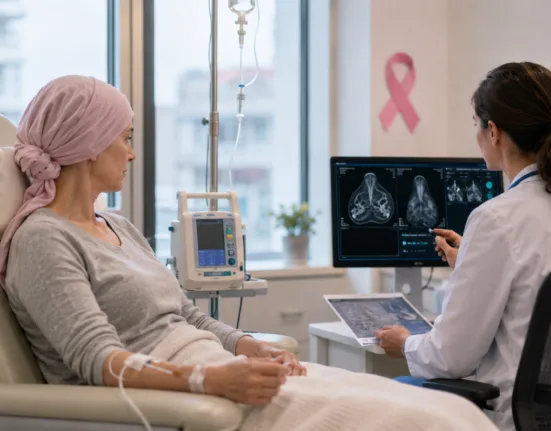
Moderna, Inc. and Merck & Co., Inc. have delivered the first positive Phase 3 readout for an individualized neoantigen therapy, reporting that intismeran autogene combined with Keytruda improved both recurrence-free survival and distant metastasis-free survival compared with Keytruda alone in patients whose high-risk melanoma had been completely removed surgically. The finding pushes personalized mRNA cancer treatment across a threshold the field has pursued for years, although the companies have not yet released the hazard ratios, event counts, Kaplan-Meier curves or detailed subgroup results needed to determine the precise magnitude and consistency of the benefit.
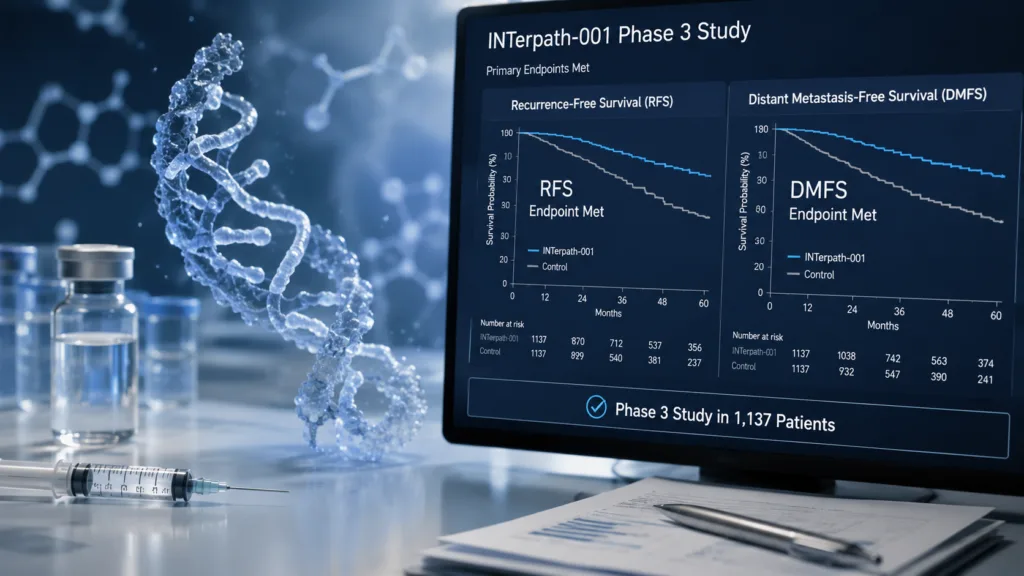
The global Phase 3 INTerpath-001 study enrolled 1,137 patients with completely resected stage IIB, IIC, III or IV cutaneous melanoma who had not previously received systemic therapy. Participants were randomized two-to-one to receive the individualized mRNA therapy plus pembrolizumab or pembrolizumab alone, making the trial substantially larger and more rigorous than the Phase 2b study that originally established proof of concept for the combination. At a prespecified interim analysis, the combination produced statistically significant and clinically meaningful improvements in the primary recurrence-free survival endpoint and the key secondary endpoint of distant metastasis-free survival. Overall survival remains under follow-up.
The result is clinically important because pembrolizumab is already an established adjuvant treatment for appropriately selected patients with resected high-risk melanoma. Intismeran therefore did not succeed against placebo or observation; it had to demonstrate added benefit on top of active anti-PD-1 therapy. Merck and Moderna characterized INTerpath-001 as the first Phase 3 study to show clinically meaningful improvement over pembrolizumab alone in this adjuvant melanoma population.
How does intismeran turn an individual patient’s tumor into an mRNA therapy?
Intismeran autogene, previously known as V940 or mRNA-4157, is not manufactured as one identical treatment administered to every patient. The process begins with tumor tissue from the individual patient, which is analyzed to identify mutations capable of producing neoantigens, abnormal protein fragments that may distinguish cancer cells from healthy tissue.
An algorithm selects tumor-specific neoantigens considered suitable for inclusion, and a synthetic messenger RNA construct encoding as many as 34 neoantigens is manufactured for that patient. Once administered, the mRNA is translated by the body’s cells and the encoded antigens can be presented to the immune system, with the objective of generating T-cell responses directed against cancer cells carrying those mutations.
Pembrolizumab approaches the immune problem from another direction. By blocking PD-1 signaling, the antibody can reduce an inhibitory checkpoint used by tumors to suppress T-cell activity. The scientific rationale for the combination is therefore complementary: intismeran attempts to broaden or sharpen recognition of tumor-specific targets, while pembrolizumab helps sustain immune activity against the cancer.
That manufacturing model is what makes the Phase 3 success particularly consequential. Personalized cancer vaccines have historically confronted not only biological uncertainty but also practical questions about tumor sequencing, computational antigen selection, patient-specific manufacturing and delivery within a clinically relevant timeframe. A positive global pivotal trial suggests that those logistical steps can be incorporated into a study involving more than 1,100 patients rather than remaining confined to small experimental cohorts.
The commercial challenge will be tougher. A clinical trial operates within controlled infrastructure, while routine treatment will require tumor collection, sequencing, manufacturing and quality release to work predictably across oncology centers treating large numbers of patients.
What exactly did INTerpath-001 prove, and what has not yet been disclosed?
Patients assigned to the combination received intismeran at 1 mg every three weeks for as many as nine doses and Keytruda at 400 mg every six weeks for up to nine cycles, covering approximately one year of treatment. The control group received pembrolizumab for approximately the same period. Treatment could stop sooner for disease recurrence, unacceptable toxicity or other protocol-defined reasons.
Recurrence-free survival measured the time until local, regional or distant disease recurrence, or death from any cause. Distant metastasis-free survival focused more specifically on development of metastatic disease or death, while overall survival, safety, tolerability and quality of life are among the additional endpoints being evaluated.
Both announced efficacy endpoints were met, but the topline disclosure deliberately leaves several questions unanswered. Moderna and Merck have not yet published the Phase 3 hazard ratios, absolute recurrence rates, median follow-up, subgroup performance or detailed adverse-event tables.
Those omissions do not weaken the statistical declaration that the trial met its endpoints, but they prevent clinicians from fully judging the clinical trade-off. A statistically significant result can represent very different degrees of benefit depending on the absolute event rates, confidence intervals, treatment duration and toxicity associated with achieving it.
The companies said the safety profile was consistent with earlier experience and that no new safety signals emerged. Detailed safety data will be especially relevant because adjuvant therapy is administered after visible cancer has already been surgically removed, meaning clinicians are treating patients to reduce the risk of future recurrence rather than to shrink measurable metastatic disease. The tolerance for incremental toxicity can therefore differ from the metastatic setting.
Merck and Moderna plan to present the full data at an international medical meeting and engage regulatory authorities regarding potential filings.
Why does the earlier Phase 2b result make the Phase 3 outcome more credible?
INTerpath-001 follows the randomized Phase 2b KEYNOTE-942 study, which provided the original clinical signal supporting rapid expansion of the programme.
At a planned five-year follow-up reported in 2026, intismeran plus pembrolizumab was associated with a 49% reduction in the risk of recurrence or death compared with pembrolizumab alone, corresponding to a recurrence-free survival hazard ratio of 0.51. The combination also produced a 59% reduction in the risk of distant metastasis or death, with a hazard ratio of 0.411.
The durability of that signal was important because an individualized immune therapy intended to prevent melanoma recurrence needs to demonstrate more than a short delay in relapse. Persistent separation of the survival curves over several years increased confidence that the original randomized result was not merely an early fluctuation.
Phase 2b remained too small to establish a new treatment standard on its own, however. The pivotal trial increased enrollment to 1,137 participants, broadened the stage range to include high-risk stage II disease and applied the combination in a blinded Phase 3 design.
The positive Phase 3 result therefore represents replication at a much larger scale rather than an isolated first signal.
What remains unknown is whether the magnitude of benefit in INTerpath-001 approaches the striking hazard ratios observed in the smaller Phase 2b study. Until the companies release the actual Phase 3 estimates, extrapolating the earlier 49% and 59% relative risk reductions to the pivotal population would be inappropriate.
Could melanoma validation support intismeran across other cancers?
This is where the consequences extend beyond a single indication.
Merck and Moderna are running nine Phase 2 and Phase 3 studies within the INTerpath programme across melanoma, non-small cell lung cancer, bladder cancer and renal cell carcinoma, alongside additional studies examining the platform in other settings. Moderna’s current pipeline includes multiple Phase 3 intismeran studies in non-small cell lung cancer and other trials spanning different stages of solid tumors.
The biological argument for individualized neoantigen therapy is not restricted to melanoma. Many cancers accumulate mutations capable of creating tumor-specific neoantigens, giving the platform a theoretically broad addressable landscape.
The probability of success may nevertheless differ materially between tumors. Melanoma is highly immunogenic and has historically responded well to immune-checkpoint inhibition, making it a favorable environment in which to test a therapy designed to generate or expand tumor-specific immune responses.
A positive melanoma trial therefore validates the manufacturing and immunological strategy more strongly than it validates efficacy in every cancer type. Lung, bladder, kidney and other cancers will still need their own randomized evidence.
The Phase 3 result should also encourage further development across the wider personalized cancer vaccine field. Competing platforms use mRNA, peptides, dendritic cells and other methods to present patient-specific tumor antigens. Until now, much of the field’s promise has been supported by early clinical studies rather than successful pivotal trials.
INTerpath-001 changes that evidentiary ceiling.
What are the biggest obstacles between positive Phase 3 results and routine cancer care?
Regulatory filing is now the obvious next step, but individualized manufacturing could become as important as regulatory review.
Traditional biologics can be manufactured in large batches and distributed across treatment centers. Intismeran requires a different chain in which tumor tissue must be obtained, sequenced and analyzed before an individualized medicine is produced for one specific patient.
Moderna has already invested in manufacturing infrastructure for intismeran and previously indicated that its Marlborough facility had begun supplying clinical batches. The ability to shorten production turnaround time, maintain batch quality and serve patients across multiple geographies will become central if regulatory approvals follow.
Reimbursement could present another challenge. Personalized manufacturing, pembrolizumab treatment and the associated diagnostic workflow could produce a complex total treatment cost, meaning payers will want to understand the absolute reduction in recurrence and whether avoiding metastatic disease offsets part of that expenditure.
Overall survival will remain another important measure. Preventing or delaying recurrence is clinically meaningful in high-risk melanoma, but a mature survival benefit would strengthen the case for exposing patients to an additional personalized therapy after surgery.
The companies have not yet reached that point. INTerpath-001 remains in follow-up for overall survival, and no regulatory application has yet been approved.
Still, the significance of the current milestone is difficult to dismiss. Personalized cancer vaccines have spent decades cycling between intense scientific optimism and disappointing clinical translation. Moderna and Merck have now shown in a randomized global Phase 3 study that an mRNA medicine manufactured around the mutational fingerprint of an individual tumor can improve major disease-control endpoints when added to an established immunotherapy.
The unanswered question is no longer whether the concept can produce a positive pivotal trial. It is how large the benefit is, whether it improves survival, and whether healthcare systems can turn highly individualized manufacturing into a scalable treatment model.