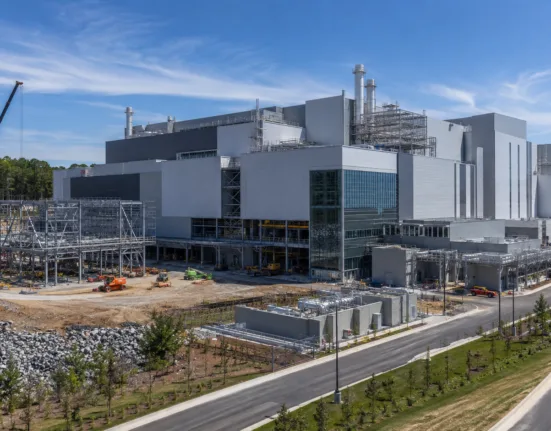
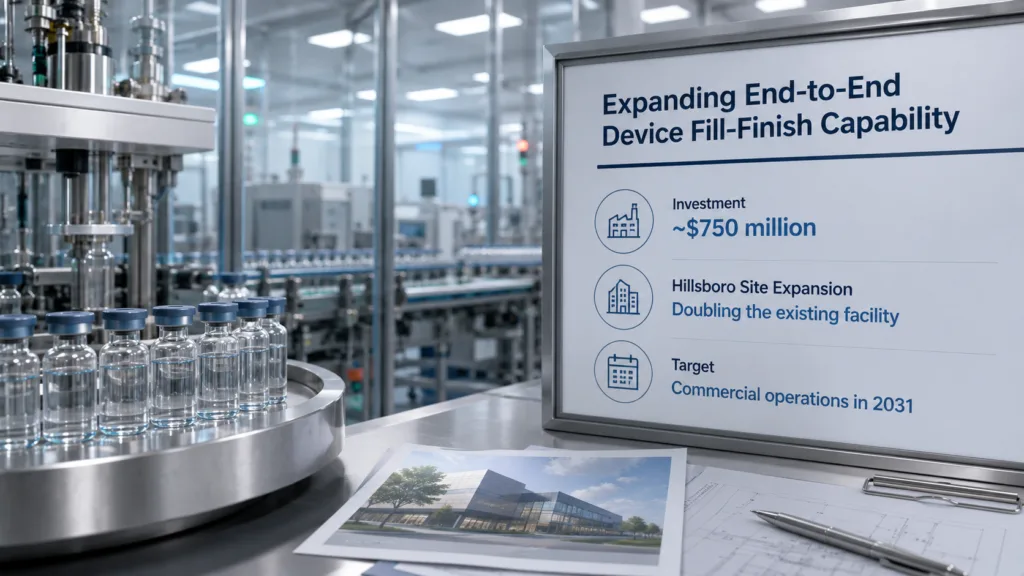
Roche Group subsidiary Genentech, Inc. plans to invest approximately $750 million in a new device fill-finish manufacturing facility at its 75-acre campus in Hillsboro, Oregon, doubling the size of a site that already plays a central role in Roche’s US drug-product supply chain and adding capacity for prefilled syringes, autoinjectors and other advanced injectable delivery formats. The project is expected to create about 250 permanent manufacturing positions and around 200 construction jobs, with commercial operations targeted for 2031.
The August 20 investment is significant because the new facility is not primarily another drug-substance factory producing bulk biologics. It addresses the final stages required to turn those medicines into patient-ready combination products, including filling injectable medicines into delivery devices capable of supporting treatment outside traditional infusion settings.
Genentech says the expansion will bring new end-to-end device-filling capabilities to Hillsboro and give Roche flexibility to support products requiring both low- and high-volume manufacturing. The company has not identified which future medicines will use the new lines, meaning the investment should be understood as portfolio-wide manufacturing infrastructure rather than capacity committed to one disclosed product.
Why is fill-finish becoming more strategically important for modern biologics?
Biologics manufacturing is frequently discussed in terms of enormous bioreactors and production of monoclonal antibodies or other complex drug substances, but commercial supply does not end when the active biological material is produced.
Drug substance must be formulated, aseptically filled into a final container, inspected, packaged and ultimately prepared in a presentation suitable for the patient or healthcare professional.
For traditional infused biologics, that might mean a vial used in a hospital or infusion center. An expanding number of medicines are instead moving toward prefilled syringes and autoinjectors intended to make subcutaneous administration easier and, in appropriate circumstances, permit treatment at home.
That shift increases manufacturing complexity because the company is effectively producing both a medicine and a delivery system whose components must function reliably together.
The Hillsboro expansion is designed specifically around these advanced drug-delivery devices. Roche says the facility will support products such as prefilled syringes and autoinjectors while providing end-to-end device filling at the Oregon campus.
The strategic advantage is flexibility. A pipeline containing numerous injectable medicines can have widely different commercial volumes, container configurations and device requirements. A site capable of filling both low-volume specialty products and much larger products gives Roche greater ability to allocate capacity internally rather than rely entirely on external manufacturers.
What role does Hillsboro already play in Roche’s US supply network?
The Oregon campus is not a greenfield manufacturing project.
Genentech’s Hillsboro Technical Operations site is Roche’s primary US drug-product manufacturing location and currently includes three filling lines, finished-goods packaging operations, a distribution center and tank-management capabilities serving Roche’s global drug-substance network. The distribution operation supplies roughly one-third of Roche’s US market.
The 75-acre campus is located about 20 miles west of Portland and has been operating for roughly two decades.
Hillsboro also houses Genentech’s Innovative Therapies operation, which supports development and manufacturing for cell and gene therapies. More than 800 people worked across Hillsboro Technical Operations and the innovative-therapies organization as of January 2026.
The $750 million project therefore adds another capability to an established manufacturing and distribution cluster rather than creating an isolated device plant.
Roche says the investment will double the size of the existing facility. The company has not publicly specified the exact square footage of the new building or the number and capacity of individual filling lines, so the $750 million headline should not be converted into a speculative estimate of how many syringes or autoinjectors the site will eventually produce.
Commercial operation is expected in 2031, emphasizing that this is long-duration capacity planning around Roche’s future pipeline rather than a near-term response to one immediate supply shortage.
Why are pharmaceutical companies moving more medicines into prefilled syringes and autoinjectors?
For selected therapies, subcutaneous self-administration can change both patient experience and healthcare-system workload.
A medicine that once required intravenous administration in an infusion center may sometimes be reformulated or developed in a presentation allowing a patient or caregiver to administer treatment at home after suitable training.
Prefilled syringes eliminate several drug-preparation steps, while autoinjectors can further simplify dosing by controlling needle insertion and medication delivery mechanically.
These formats can reduce handling complexity and potentially shift some treatment away from clinics, but they also create demanding product-development requirements. Dose volume, viscosity, injection force, container materials, needle design, device reliability and patient usability all become part of the therapeutic product.
Manufacturing accordingly becomes a convergence between pharmaceuticals and medical devices.
An injectable biologic placed inside an autoinjector cannot be treated merely as a bottle filled with medicine. Drug-device compatibility must be maintained through shelf life and transportation, while the delivery mechanism must administer the correct dose reliably.
Roche explicitly framed the Hillsboro investment around advanced delivery formats that may provide patients with more convenient treatment options.
That helps explain why fill-finish capacity has strategic value beyond simple production volume. The manufacturing network needs to support evolving modes of administration as the company’s pipeline changes.
How does the Oregon expansion fit Roche’s broader US manufacturing strategy?
Hillsboro forms part of a much larger investment programme.
Roche has been expanding US manufacturing across multiple therapeutic technologies and regions, including a major facility in Holly Springs, North Carolina. The company recently marked the topping-out of that project before announcing the Oregon expansion.
The two facilities serve complementary functions. Large-scale drug-substance capacity and device fill-finish capacity address different links in the biologics supply chain, and bringing more of those capabilities within the United States can reduce dependence on geographically dispersed external suppliers.
Genentech says the Hillsboro project will strengthen domestic medicine-supply resilience by adding end-to-end drug-device filling capability to its US network.
There is also a strategic policy backdrop. Pharmaceutical companies have faced increasing political and regulatory pressure to strengthen domestic manufacturing while governments scrutinize supply-chain dependence exposed by shortages and geopolitical disruption.
Roche’s investment should not be reduced purely to that policy environment, however. The 2031 timeline and focus on flexible drug-device capability indicate that pipeline requirements and changes in medicine delivery are central to the business case.
Manufacturing investments of this scale require years of design, construction, qualification and regulatory readiness. Capacity therefore has to be built before the company knows with certainty which late-stage pipeline products will become major commercial medicines.
Why does flexible capacity matter when Roche does not know which pipeline drugs will succeed?
Drug development creates a structural manufacturing problem.
A pharmaceutical company has to prepare for successful launches before regulators approve the medicines, yet many clinical programmes ultimately fail. Building a dedicated facility for one pipeline asset years before approval can therefore leave stranded capacity if development does not succeed.
Flexible manufacturing is one way to manage that uncertainty.
Genentech says the Hillsboro expansion will support both low- and high-volume products, allowing equipment and production capacity to serve multiple future medicines rather than being restricted to one fixed commercial forecast.
This becomes particularly useful for Roche because its portfolio spans oncology, immunology, neurology, ophthalmology and other therapeutic areas, with individual biologics potentially requiring substantially different annual volumes.
A rare-disease medicine administered by autoinjector might require relatively modest production volumes, while a therapy reaching a much larger chronic-disease population could require millions of device units.
Flexibility also helps manage lifecycle changes. A medicine initially launched in a vial may later move into a prefilled syringe or autoinjector presentation, expanding manufacturing requirements after the original approval.
Hillsboro’s new capabilities could therefore support not only completely new molecules but potentially different delivery formats for medicines already in Roche’s portfolio, although the company has not identified specific products.
What are the manufacturing risks behind a 2031 commercial target?
Building the physical facility is only the first part of the project.
Aseptic fill-finish plants operate under stringent current good manufacturing practice requirements because contamination or process-control failures can compromise sterile injectable products. Equipment must be installed and qualified, processes validated, personnel trained and regulatory inspections completed before commercial product can move through the lines.
Drug-device products add further validation work because the filling operation must interact consistently with container and delivery-system components.
The five-year horizon before expected commercial operation is therefore not unusual for a project of this complexity.
Genentech must also manage the facility through a period in which device technologies may continue to evolve. Higher-concentration formulations, larger-volume injectors and connected delivery devices could alter the type of manufacturing capability demanded by future medicines.
Designing enough flexibility into the site becomes critical when the investment has to remain useful for decades rather than one launch cycle.
Supply-chain resilience also depends on more than owning a fill-finish plant. Syringes, cartridges, elastomer components, device assemblies and other materials still come from specialized suppliers, leaving manufacturers exposed to shortages or quality problems elsewhere in the chain.
The new site nevertheless allows Roche to control one of the most technically and regulatorily sensitive stages itself.
What does the $750 million investment signal about the future of pharmaceutical manufacturing?
Roche’s Oregon project reflects a broader transition in which the boundary between a drug and its delivery device is becoming less distinct.
Pharmaceutical value has traditionally concentrated on discovering an active molecule and proving that it treats disease. For many injectable biologics, the commercial product increasingly includes another layer: how easily, reliably and conveniently the medicine can reach the patient.
That makes device engineering, aseptic filling and final product assembly strategic capabilities rather than downstream packaging activities.
The $750 million cost and five-year development timeline illustrate the scale of infrastructure required behind something that may ultimately look deceptively simple to a patient: a prefilled syringe removed from a refrigerator or an autoinjector pressed against the skin.
Hillsboro already occupies an important position in Roche’s US supply network, handling filling, packaging and distribution. Doubling the site with end-to-end drug-device capabilities gives the company more control over the next generation of injectable presentations while adding 250 permanent manufacturing jobs.
The commercial payoff will not be visible in 2026. Operations are not expected until 2031, and Roche has not named the medicines that will eventually fill the new capacity.
That long horizon is precisely what makes the investment notable. Roche is building manufacturing infrastructure around an expectation that advanced injectable devices will become more important across its future biologics portfolio, meaning the delivery system is increasingly becoming part of the medicine strategy itself.