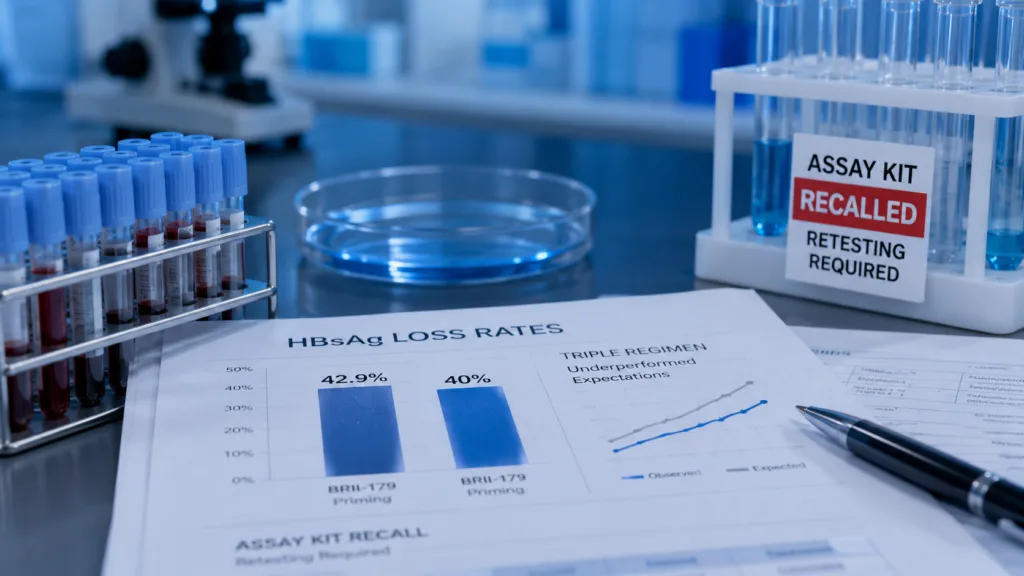
Brii Biosciences Limited (HKEX: 2137) has provided a more complete picture of how it intends to pursue a functional cure for chronic hepatitis B after Phase 2b data produced sharply different outcomes depending on when its BRII-179 immunotherapeutic was administered. In the ENRICH study, patients primed with BRII-179 before receiving the HBV-targeting siRNA elebsiran and pegylated interferon alfa achieved end-of-treatment hepatitis B surface antigen loss rates of 42.9% and 40% across two dosing schedules, reinforcing the company’s view that stimulating HBV-specific immunity before antiviral intensification may be more useful than simply administering all three agents simultaneously. By contrast, the concurrent triple regimen evaluated in ENHANCE produced a 25.5% HBsAg loss rate and failed to improve on the 29.7% historical rate cited from comparable ENSURE combination cohorts.
The August 21 update adds an unusual complication: Brii Bio said one of its central laboratory providers notified the company on August 19 of a recall involving a commercial assay kit used for HBsAg testing in ENHANCE. Based on its preliminary review, Brii believes the potentially affected data are limited to the end-of-treatment results from ENHANCE Part A-2, where the reported HBsAg loss rate was 22.5%, or 18 of 80 participants. The company is identifying affected samples and arranging retesting with unaffected kits and says it has not yet found evidence that the issue changes its overall programme decisions, but the incident means that specific cohort should be treated as provisional until retesting is complete.
Why is HBsAg loss so important in chronic hepatitis B development?
Current nucleos(t)ide analogue therapies can suppress HBV replication extremely effectively, reducing liver injury and lowering the risk of cirrhosis and hepatocellular carcinoma. The challenge is that they usually do not eliminate the persistent viral reservoir responsible for chronic infection, meaning many patients remain on treatment indefinitely.
HBsAg loss is therefore used as a central marker in efforts to achieve a functional cure, generally meaning sustained loss of detectable hepatitis B surface antigen with or without development of anti-HBs antibodies after treatment is discontinued. That definition makes timing critical: an end-of-treatment HBsAg loss result can be highly encouraging, but durable functional cure ultimately requires evidence that control persists after therapy stops.
Brii’s current Phase 2b numbers consequently describe end-of-treatment antigen loss rather than final proof of sustained functional cure. The company has longer follow-up evidence from ENSURE supporting durable responses in some patients and intends to present more detailed ENRICH and ENHANCE analyses during the second half of 2026.
Why did BRII-179 perform better as a priming therapy?
BRII-179 is a recombinant protein-based HBV immunotherapeutic designed to stimulate virus-specific immune responses. Chronic hepatitis B is difficult to cure partly because years of persistent antigen exposure can leave antiviral immune cells functionally exhausted or insufficiently responsive, meaning suppressing viral replication alone may not restore the immune control required after medicines are discontinued.
ENRICH tests the hypothesis that immune stimulation should occur first. One group received five BRII-179 doses every three weeks before elebsiran and pegylated interferon, while another received seven doses every two weeks. HBsAg loss at the end of treatment reached 42 of 98 participants, or 42.9%, in the five-dose schedule and 20 of 50, or 40%, in the seven-dose schedule. Those figures closely resemble the 41.9% rate previously observed among BRII-179-experienced patients in ENSURE Cohort 4, giving Brii a repeated signal that prior immunotherapeutic exposure may influence later combination efficacy.
Brii also reported encouraging subgroup behavior among participants entering treatment with relatively high HBsAg levels of 1,000 to 3,000 IU/mL, a population that can be particularly difficult to push toward antigen loss. Those analyses are not substitutes for randomized comparison and detailed data remain pending, but they support the company’s argument that immune priming might make subsequent antiviral therapy effective across a wider baseline-antigen range.
Why did giving all three therapies together fail to improve the result?
ENHANCE Part A-1 tested concurrent BRII-179, elebsiran and pegylated interferon. Its 25.5% end-of-treatment HBsAg loss rate, representing 25 of 98 patients, was numerically higher than the 10.2% rate in a historical pegylated-interferon control arm but below the 29.7% rate cited from ENSURE Cohorts 2 and 3 using elebsiran and interferon without the same BRII-179 strategy. Brii therefore concluded that simply adding its immunotherapeutic concurrently did not improve HBsAg loss in the way the company had hoped.
That finding is scientifically useful even though it is negative from a development perspective. Immune therapies can be highly dependent on sequence because viral antigen burden, innate signaling and interferon exposure can influence whether T- and B-cell responses become productively activated. BRII-179 may therefore require a period of immune priming before strong antiviral pressure and interferon are introduced rather than being most useful when all components arrive simultaneously.
The result also demonstrates why multidrug functional-cure programmes need more than an assumption that adding another active mechanism will automatically improve efficacy. Combination sequencing can become as important as the individual medicines.
What did the shortened-interferon strategy show before the assay issue emerged?
ENHANCE Part A-2 explored a sequential regimen intended partly to reduce the burden of pegylated interferon. Patients received BRII-179 plus elebsiran for 24 weeks followed by 24 weeks of elebsiran and pegylated interferon, producing a reported end-of-treatment HBsAg loss rate of 22.5%. Brii interpreted that result as evidence that a full interferon course may be important for maximizing HBsAg loss.
The assay recall now introduces uncertainty around precisely that number. Brii has not said the entire Part A-2 result is invalid, nor has it identified evidence that other reported ENRICH or ENHANCE datasets are materially affected. Instead, it says potentially impacted samples are being identified and retested.
This distinction matters because the recall concerns a commercial laboratory assay kit used to measure HBsAg, not BRII-179, elebsiran or any other therapeutic product. It is a clinical-data integrity issue rather than a drug recall, and retesting may ultimately confirm the original interpretation. Until that process is complete, however, the 22.5% Part A-2 figure carries an additional analytical qualification that the ENRICH results do not.
What role does elebsiran play in the functional-cure strategy?
Elebsiran is an siRNA designed to suppress HBV RNA and consequently reduce production of viral proteins including HBsAg. The theoretical advantage is that lowering antigen burden can reduce the persistent viral stimulation believed to contribute to immune exhaustion, potentially creating conditions in which immunotherapeutic stimulation and interferon become more effective.
That creates a multi-step biological strategy: siRNA reduces viral antigen production, BRII-179 attempts to rebuild HBV-specific immunity and pegylated interferon adds antiviral and immunomodulatory pressure. The ENRICH result suggests the sequence of those mechanisms may determine whether the combination produces substantially more HBsAg loss than conventional approaches.
There is also a nonclinical complication around programme execution. Brii previously said advancement of ENRICH into Phase 3 remained subject to the outcome of arbitration with Vir Biotechnology concerning manufacturing technology transfer for elebsiran. That means a potentially registrational strategy could depend not only on the final clinical dataset but also on resolution of the partnership and manufacturing framework surrounding one of the combination components.
How should the 42.9% figure be interpreted before Phase 3?
The result is large enough to merit attention, particularly because it is consistent with a prior BRII-179-experienced cohort rather than appearing in isolation. It does not yet establish that 42.9% of treated patients will achieve a durable functional cure, because the current number is measured at the end of therapy and because cross-study comparisons carry substantial limitations.
Detailed ENRICH data will need to show baseline characteristics, HBsAg trajectories, anti-HBs responses, safety, durability and whether patients remain antigen negative after therapy is removed. Brii reported no new safety concerns across ENSURE, ENRICH and ENHANCE to date, but the eventual risk-benefit assessment will also have to consider the tolerability of prolonged pegylated interferon exposure.
The strategic direction is nevertheless becoming clearer. BRII-179 appears more promising when used to prepare the immune system before the antiviral combination than when simply added concurrently. That narrows the development hypothesis, which is valuable after several complex Phase 2 programmes.
The next challenge is proving durability. HBV functional cure is not defined by winning the HBsAg race on the final treatment day; it is defined by whether control survives when the medicines are gone.